
This page is brought to you by Brian Golding (Golding@McMaster.CA) and is copied locally here to speed your access. To go to the original page (should you find something interesting or should you wish to follow links) click on

Current Issue of Nature


Volume 654 Issue 8119, 18 June 2026
Skip to main content

Thank you for visiting nature.com. You are using a browser version with limited support for CSS. To obtain the best experience, we recommend you use a more up to date browser (or turn off compatibility mode in Internet Explorer). In the meantime, to ensure continued support, we are displaying the site without styles and JavaScript.

Volume 654 Issue 8119, 18 June 2026

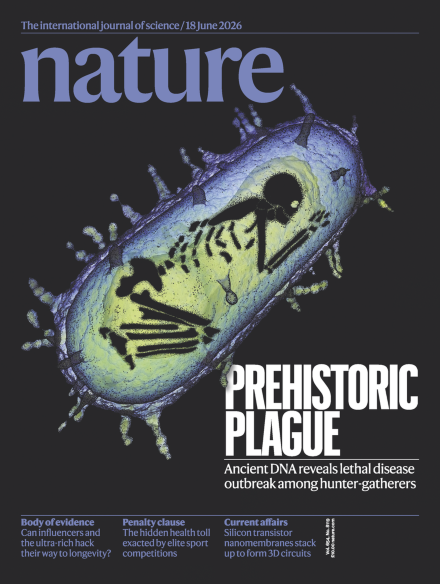
Prehistoric plague

Plague is notorious, having caused some of the deadliest outbreaks of disease in history. But its origins and how it affected early human populations remain obscure. In particular, ancient strains of Yersinia pestis, the bacterium that causes plague, discovered so far have lacked the classic genes required for virulence, raising questions over how deadly early forms of the disease might have been. In this week’s issue, Eske Willerslev and colleagues reveal evidence of deadly plague outbreaks in prehistoric communities dating back some 5,500 years ago. The researchers analysed DNA from the remains of 42 hunter-gatherers buried in southeast Siberia. They found evidence of Y. pestis in 18 individuals and were able to show that the individuals came from close family groups, consistent with human-to-human transmission. The strain of Y. pestis was different from those already known from other ancient and modern strains, and the team estimates that this strain emerged at a minimum of 5,700 years ago. The results suggest that deadly plague outbreaks occurred within hunter-gather populations hundreds of years before it was seen in Neolithic populations, which the authors say challenges the idea that high population densities and the transition to agriculture were prerequisites for plague epidemics.

Cover image: Katherine Hearne.
This Week

Top of page ⤴

News in Focus

Top of page ⤴

Books & Arts

Top of page ⤴

Opinion

Top of page ⤴

Work

Top of page ⤴

Research

  • News & Views

  • Perspective

    • Although Antarctic ice loss projections diverge widely by 2100, this Perspective shows that present-day rates robustly predict mid-century sea level rise, providing a firm basis for near-term planning, while highlighting priorities for model development aimed at resolving longer-term sea level rise uncertainty.

      • Felicity S. McCormack
      • Mathieu Morlighem
      • Hélène Seroussi
      Perspective
  • Articles

    • The scattering of high-energy electrons from three different nuclei demonstrated that short-range-correlated pairing depends far more on the specific quantum orbitals occupied by nucleons than predicted by theoretical models.

      • D. Nguyen
      • C. Yero
      • E. W. Wertz
      Article
    • A prototype differential atom interferometer operates at the standard quantum limit with no excess noise beyond atom shot noise, achieving performance in line with the specifications for future long-baseline atom interferometers.

      • C. F. A. Baynham
      • R. Hobson
      • M. G. D. van der Grinten
      Article Open Access
    • Macroscopic quantum coherence arises in two-component exciton Bose–Einstein condensates within MoSe2/hBN/WSe2 electron–hole bilayers, exhibiting distinct spin–valley polarized phases, quantum phase transitions under magnetic fields and stable condensate behaviour up to approximately 1.8 K.

      • Ruishi Qi
      • Qize Li
      • Feng Wang
      Article
    • A new polaritonic optical method that uses the mid-infrared out-of-plane hyperbolic polaritons mode is described and experimentally validated to allow the examination of picometre-scale interlayer deformations, providing a bridge between nanomechanics and photonics.

      • Shu Zhang
      • Xiangdong Guo
      • Qing Dai
      Article
    • Uniformly doped, ultrathin single-crystalline silicon nanomembranes can be vertically stacked at low temperature using a roll-transfer-printing process that is scalable to wafer scale and tolerant to substrate topology and surface roughness for constructing high-performance monolithic three-dimensional integrated circuits.

      • Bao Lam
      • Yung Man Yu
      • Qing Cao
      Article
    • By tuning the stereoelectronic properties of ligand adsorption topology to optimize the interfacial architecture and improve stability in perovskite solar cells, high certified power outputs of nearly 27% in the laboratory are demonstrated.

      • Tinghuan Yang
      • Erxin Zhao
      • Kui Zhao
      Article Open Access
    • Analysis of a 25-year satellite record shows that Earth has a persistent east–west albedo symmetry split at 27° E, with clear-sky albedo, cloud radiative effect and open-ocean fraction exhibiting a triple symmetry around this meridian.

      • Jianhao Zhang
      • Jake J. Gristey
      • Graham Feingold
      Article Open Access
    • Quantification of links among insect pollinators, crop plants, nutrient intake and income of smallholder communities in Nepal show that pollinators substantially contribute to their income and micronutrient intake.

      • T. P. Timberlake
      • S. Sapkota
      • J. Memmott
      Article Open Access
    • Analyses of ancient DNA from hunter-gatherers near Lake Baikal in southeast Siberia around 5,500 years ago indicate that highly virulent Yersinia pestis emerged earlier than previously estimated, far from the next known cases of infection in Late Neolithic Europe.

      • Ruairidh Macleod
      • Frederik V. Seersholm
      • Eske Willerslev
      Article Open Access
    • The rate of axon ensheathment varies within individual myelinating processes, resulting in chains of myelin sheaths connected by bridges consisting of thin cytoplasmic processes that provide flexibility for myelination of highly branched axons.

      • Cody L. Call
      • Sarah A. Neely
      • Dwight E. Bergles
      Article Open Access
    • Findings suggest that neural crest fate bias predominantly emerges within the neural tube, and that only a minor subset of delaminated progenitors retain multipotency to generate both sensory and sympathetic derivatives.

      • Keng Ioi Vong
      • Yanina D. Alvarez
      • Joseph G. Gleeson
      Article
    • A brain–machine interface is used in monkeys to investigate the biophysical underpinnings of cortical high gamma-band activity, a signal that is often studied in the context of many brain functions.

      • Tianhao Lei
      • Michael R. Scheid
      • Marc W. Slutzky
      Article Open Access
    • The SARS-CoV-2 Omicron variant escapes neutralization by antibodies targeting the pan-coronavirus epitope in a spike fusion intermediate via steric hindrance, but reducing the antibody size overcomes this barrier and expands its range of accessible targets.

      • Zhiheng Bao
      • Zhimin Liu
      • Xiaoyu Sun
      Article
    • A vaccination strategy using heterologous HIV Env trimers covalently coupled to liposomes for multivalent display generates cross-neutralizing HIV serum antibody responses in non-human primates, mimicking infection-elicited apex-targeting broadly neutralizing antibodies.

      • Javier Guenaga
      • Monika Ádori
      • Richard T. Wyatt
      Article Open Access
    • The Lap-NET1 phase 1b trial reports that combined netrin1 antibody (NP137) plus modified FOLFIRINOX therapy on patients with locally advanced pancreatic cancer was well tolerated and improved progression-free survival and overall survival via inhibition of epithelial–mesenchymal transition.

      • Gael Roth
      • Pascal Artru
      • Patrick Mehlen
      Article Open Access
    • A large-scale proteomics analysis of the dark proteome by the TransCODE Consortium reveals many translated non-canonical open reading frames to encode microproteins and peptideins.

      • Eric W. Deutsch
      • Leron W. Kok
      • Sebastiaan van Heesch
      Article Open Access
Top of page ⤴

Amendments & Corrections

Top of page ⤴
Nature Briefing

Sign up for the Nature Briefing newsletter — what matters in science, free to your inbox daily.

Get the most important science stories of the day, free in your inbox. Sign up for Nature Briefing

Search

Quick links