
This page is brought to you by Brian Golding (Golding@McMaster.CA) and is copied locally here to speed your access. To go to the original page (should you find something interesting or should you wish to follow links) click on

Current Issue of Nature


Volume 652 Issue 8109, 9 April 2026
Skip to main content

Thank you for visiting nature.com. You are using a browser version with limited support for CSS. To obtain the best experience, we recommend you use a more up to date browser (or turn off compatibility mode in Internet Explorer). In the meantime, to ensure continued support, we are displaying the site without styles and JavaScript.

Volume 652 Issue 8109, 9 April 2026

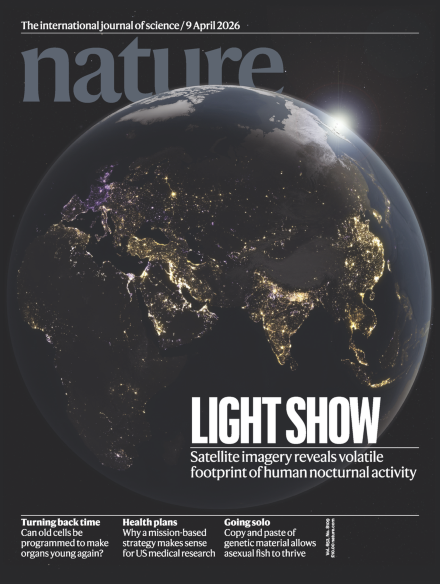
Light show

The cover image offers a night-time view of Earth, capturing human activity across the eastern hemisphere of the planet through the emissions of artificial light. Derived from satellite images taken daily over the past decade, the image maps the dynamics of the human night-time activities, with golden areas experiencing brightening, purple areas featuring dimming, and white areas experiencing both. This changing footprint is explored in this week’s issue by Tian Li, Zhe Zhu and colleagues. The researchers reveal that, rather than being a story of universal brightening, the human light footprint is a dynamic system in which brightening and dimming both occur, often simultaneously, and are intensifying. In the area surveyed, they found 51% saw only gradual changes in light, 14% experienced solely abrupt changes, and 35% saw both. These reflect changes at a local level — from power cuts to growth in urbanization. Globally, the team found that brightening contributed a 34% increase in artificial light between 2014 and 2022, but this was offset by an 18% dimming, resulting in a net 16% increase. The researchers suggest that, far from being a static beacon of growth, the pattern of artificial-light usage fluctuates with increasing volatility, echoing the heartbeat of human activity.

Cover image: Michala Garrison/NASA Earth Observatory.
This Week

Top of page ⤴

News in Focus

Top of page ⤴

Books & Arts

Top of page ⤴

Opinion

Top of page ⤴

Work

Top of page ⤴

Research

  • News & Views

  • Perspective

  • Articles

    • Large-scale lattice quantum chromodynamics simulations enable a model-free, highly precise determination of the strong coupling constant αs, reducing theoretical uncertainty and improving precision tests of particle physics.

      • Mattia Dalla Brida
      • Roman Höllwieser
      • Rainer Sommer
      Article Open Access
    • Researchers created a moiré superlattice in Sb2Te3/FeTe bilayers, producing spatially modulated superconducting gaps directly imaged with Josephson scanning tunnelling microscopy and spectroscopy, tunable by replacing Sb2Te3 with Bi2Te3.

      • Zihao Wang
      • Bing Xia
      • Cui-Zu Chang
      Article
    • Analysis of FeTe films grown using molecular-beam epitaxy and annealed under a Te flux post-growth shows that stoichiometric FeTe is inherently a superconductor, contradicting the long-held view that it is an antiferromagnetic metal.

      • Zi-Jie Yan
      • Zihao Wang
      • Cui-Zu Chang
      Article
    • A dual-action force dynamics strategy using a hard silicon template as a nanoimprinting stamp combined with inverted transfer printing is described for the manufacture of high-performance full-colour ultrahigh-resolution quantum dot light-emitting diodes (LEDs) for active-matrix displays, while revealing electric-field reconstruction in nanoscale arrays and introducing dielectric matching to mitigate field concentration and performance degradation.

      • Lihua Lin
      • Jie Wang
      • Fushan Li
      Article
    • Sedimentary time-series data of Lake Yoa in Chad covering the past 10.25 thousand years (kyr) show that the mid-Holocene African Humid Period experienced several decadal-scale droughts, caused by sudden inputs of freshwater into the North Atlantic.

      • Florence Sylvestre
      • Martin Melles
      • Stefan Kröpelin
      Article
    • Data from the recently launched SWOT satellite, a wide-swath satellite altimeter, have been used to map tidal dynamics for thousands of coastal rivers and to document the factors controlling the inland extent of tides.

      • M. G. Hart-Davis
      • D. Scherer
      • F. Seitz
      Article Open Access
    • Magma drilling data from Krafla volcano, Iceland, are used to reconstruct in situ lithostatic magmatic conditions using disequilibrium simulations that provide a method for improving the understanding of magma storage conditions and evolution.

      • Janine Birnbaum
      • Fabian B. Wadsworth
      • Yan Lavallée
      Article Open Access
    • Survival of reef-building oysters peaks at specific combinations of fractal dimension and height that reduce predation, showing how optimal three-dimensional habitat geometry can guide more effective ecosystem restoration.

      • Juan R. Esquivel-Muelbert
      • Luisa Fontoura
      • Melanie J. Bishop
      Article Open Access
    • Analysis of the asexually reproducing Amazon molly Poecilia formosa and its sexually reproducing progenitors Poecilia mexicana and Poecilia latipinna reveals that it maintains a divergent mutational landscape and has evaded functional mutational decay via gene conversion.

      • Edward S. Ricemeyer
      • Nathan K. Schaefer
      • Wesley C. Warren
      Article
    • Sequencing of marine sediments finds 136 newly identified Heimdallarchaeia and several novel lineages, and indicates that Heimdallarchaeia evolved distinct metabolic capabilities from other Asgardarchaeota, in conditions that may have given rise to early eukaryotes.

      • Kathryn E. Appler
      • James P. Lingford
      • Brett J. Baker
      Article
    • Among users initially on a chronological feed, 7 weeks of exposure to X’s algorithmic feed in 2023 shifted political attitudes and account-following behaviour in a more conservative direction compared with those remaining on a chronological feed, whereas switching the feed setting in the opposite direction, from algorithmic to chronological, had no effect.

      • Germain Gauthier
      • Roland Hodler
      • Ekaterina Zhuravskaya
      Article Open Access
    • Cue-evoked striatal dopamine release in mice encodes bidirectional trajectory errors, spatially and temporally separated from value coding, reflecting the relationship between the speed and direction of ongoing movement relative to optimal goal trajectories.

      • Eleanor H. Brown
      • Yihan Zi
      • Mark W. Howe
      Article
    • Age-related microbiome changes increase medium-chain fatty acid-producing bacteria, driving GPR84-mediated myeloid inflammation, impaired vagal signalling and hippocampal dysfunction; targeting this gut–brain pathway restores memory in aged mice.

      • Timothy O. Cox
      • Ashwarya S. Devason
      • Christoph A. Thaiss
      Article Open Access
    • A machine-learning model that integrates data from wearable devices (such as smartwatches) with blood biomarkers and demographic data can predict whether someone has insulin resistance, enabling timely lifestyle interventions to prevent progression to type 2 diabetes.

      • Ahmed A. Metwally
      • A. Ali Heydari
      • Javier L. Prieto
      Article Open Access
    • Single-particle tracking experiments in intact cells reveal dynamic co- and post-translational interactions of the TRiC–PFD chaperonin complex with client proteins during in vivo protein folding.

      • Rongqin Li
      • Niko Dalheimer
      • F. Ulrich Hartl
      Article Open Access
    • An approach to discover reactive diazo-based metabolites by capture based on their reactivity coupled to mass spectrometry revealed two previously unknown diazo-containing compounds produced by the human lung pathogen Nocardia ninae using novel biosynthetic chemistry.

      • Katarina Pfeifer
      • Devon Van Cura
      • Emily P. Balskus
      Article Open Access
Top of page ⤴

Amendments & Corrections

Top of page ⤴
Nature Briefing

Sign up for the Nature Briefing newsletter — what matters in science, free to your inbox daily.

Get the most important science stories of the day, free in your inbox. Sign up for Nature Briefing

Search

Quick links