
This page is brought to you by Brian Golding (Golding@McMaster.CA) and is copied locally here to speed your access. To go to the original page (should you find something interesting or should you wish to follow links) click on

Current Issue of Nature


Volume 652 Issue 8111, 23 April 2026
Skip to main content

Thank you for visiting nature.com. You are using a browser version with limited support for CSS. To obtain the best experience, we recommend you use a more up to date browser (or turn off compatibility mode in Internet Explorer). In the meantime, to ensure continued support, we are displaying the site without styles and JavaScript.

Volume 652 Issue 8111, 23 April 2026

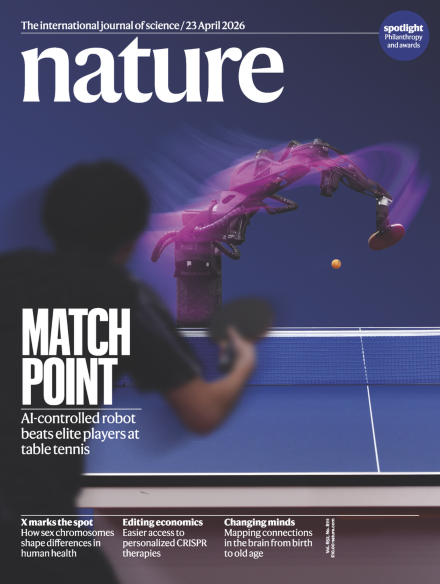
Match point

Table tennis is a highly dextrous sport that requires rapid reflexes and an ability to respond to unpredictable gameplay, all of which presents a significant challenge for robots. Some robotic systems have taken up a bat, but have only been able to operate under simplified rules or against amateur players. In this week’s issue, Peter Dürr and colleagues present Ace, an autonomous robot that can outplay elite table tennis players under official competition rules. Ace consists of a network of cameras, an AI-based control system and a high-speed robot arm with eight joints. The researchers tested Ace in a series of matches against five elite and two professional players. The system won three of its five matches against the elite players and, although it lost both matches against the professional players, it was still managed to win a game against one of them. The cover photo captures Ace in action against one of the elite players. Overall, the team notes that Ace was able to add a variety of spin types to its gameplay as well as reacting quickly to unusual shots.

Cover image: Sony AI.
This Week

Top of page ⤴

News in Focus

Top of page ⤴

Books & Arts

Top of page ⤴

Opinion

Top of page ⤴

Work

Top of page ⤴

Research

  • News & Views

  • Analysis

    • An oriented spin space group description is proposed that unifies the spin space group and magnetic space group frameworks, enabling a comprehensive symmetry classification of the magnetic materials on a large scale and identifying spin–orbit magnetism as a distinct phase.

      • Yuntian Liu
      • Xiaobing Chen
      • Qihang Liu
      Analysis Open Access
  • Articles

    • LIGO–Virgo–KAGRA’s fourth Gravitational-Wave Transient Catalog shows evidence of a clear pair-instability gap in the distribution of binary black-hole secondary masses but is absent in the larger primary masses.

      • Hui Tong
      • Maya Fishbach
      • Aditya Vijaykumar
      Article
    • An autonomous robot system, Ace, combines event-based vision and reinforcement learning to compete with elite human table tennis players, highlighting the potential of physical AI agents to perform complex, real-time interactive tasks.

      • Peter Dürr
      • Mireille El Gheche
      • Michael Spranger
      Article Open Access
    • A monolithic mode-locked semiconductor laser with a continuously and widely tunable repetition rate is achieved by using a microwave driving signal that induces a spatiotemporal gain modulation along the entire laser cavity.

      • Urban Senica
      • Michael A. Schreiber
      • Giacomo Scalari
      Article
    • Monolithic three-dimensional (3D) integration of tantalum pentoxide on a lithium niobate substrate enables scalable, multifunctional photonic systems and the incorporation of nonlinear optics directly into existing and emerging photonics infrastructure.

      • Grant M. Brodnik
      • Grisha Spektor
      • Scott B. Papp
      Article
    • Operando birefringence microscopy measurements of the stresses around growing dendrites in solid electrolytes show that stresses decrease as current densities increase, revealing a linkage between electrochemical and mechanical stability that informs the design of solid-state batteries.

      • Cole D. Fincher
      • Colin Gilgenbach
      • Yet-Ming Chiang
      Article
    • Cryogenic electron microscopy images and micromechanical fracture modelling of mechanically soft lithium dendrites fracturing hard ceramic electrolytes suggest the mechanisms driving the phenomenon as well as design implications for solid-state lithium metal batteries.

      • Yuwei Zhang
      • Soroush Motahari
      • Gerhard Dehm
      Article Open Access
    • A new platform using a recyclable selenanthrene reagent that mediates alkenes desaturation to alkynes under mild conditions is described for improving existing methods for the conversion of alkenes to alkynes, which originate from the 1860s.

      • Junhong Meng
      • Yiqi Liang
      • Ning Jiao
      Article
    • A time-dependent model shows chondrite precursors formed by non-equilibrium condensation: cooling rate and pressure alone generate three mineral classes with increasing oxidation, matching enstatite, ordinary and carbonaceous chondrites without large redox variations in the solar nebula.

      • Sébastien Charnoz
      • Jérôme Aléon
      • Patrick Franco
      Article Open Access
    • Megachelicerax cousteaui gen. et sp. nov. is a large soft-bodied arthropod from the middle Cambrian of Utah featuring massive three-segmented chelicerae, along with five pairs of pseudobiramous prosomal limbs with non-foliaceous exopodal rami, and plate-like lamellae-bearing opisthosomal appendages.

      • Rudy Lerosey-Aubril
      • Javier Ortega-Hernández
      Article
    • fMRI data from individuals of a wide range of ages (from a few days to 100 years old) are used to map the key organizational axes of functional connectivity in the human cortex throughout the lifespan.

      • Hoyt Patrick Taylor IV
      • Khoi Minh Huynh
      • Pew-Thian Yap
      Article Open Access
    • Post-transcriptional regulation of mRNA translation was explored using Ribo-STAMP and single-cell RNA sequencing to reveal cell-type-specific and isoform-specific translation patterns across hippocampal neuronal and non-neuronal cell types, highlighting functional differences between CA1 and CA3.

      • Samantha L. Sison
      • Federico Zampa
      • Giordano Lippi
      Article Open Access
    • Biochemical and structural studies show that the bacterial dGTPase CloA is activated by virally produced dTTP and inhibited by 5′-triphosphothymidyl-3′5′-thymidine produced by its regulatory partner CloB, and thereby balances antiviral defence and immune-mediated toxicity.

      • Sonomi Yamaguchi
      • Samantha G. Fernandez
      • Philip J. Kranzusch
      Article
    • Assessing thymic function and health has highlighted the lifelong importance of the thymus as an organ that could be targeted to improve health outcomes, protect against disease and promote healthy ageing.

      • Simon Bernatz
      • Vasco Prudente
      • Hugo J. W. L. Aerts
      Article Open Access
    • A deep-learning approach applied to routine CT scans is used to quantify the health of the thymus in a cohort of patients with cancer, and shows that thymic function is associated with immunotherapy outcomes.

      • Simon Bernatz
      • Vasco Prudente
      • Hugo J. W. L. Aerts
      Article Open Access
    • Individual supratentorial ependymoma tumour subgroups have two distinct progenitor-like cell states—neuroepithelial-like and embryonic-like—that are reminiscent of early human brain development and diverge in the extent of their neuronal or ependymal differentiation.

      • Daeun Jeong
      • Sara G. Danielli
      • Mariella G. Filbin
      Article Open Access
    • Single-nucleus chromatin and RNA sequencing identifies epigenetic chromatin domains that confer vulnerability to paediatric brain tumours such as ependymomas, providing insight into the development of such tumours despite ‘quiet’ genomes.

      • Alisha S. Kardian
      • Hua Sun
      • Stephen C. Mack
      Article Open Access
Top of page ⤴

Amendments & Corrections

Top of page ⤴

Spotlight

  • In this spotlight, Nature explores the growing role of science philanthropy in response to shifts in the global funding landscape.

    Spotlight
Top of page ⤴
Nature Briefing

Sign up for the Nature Briefing newsletter — what matters in science, free to your inbox daily.

Get the most important science stories of the day, free in your inbox. Sign up for Nature Briefing

Search

Quick links