
This page is brought to you by Brian Golding (Golding@McMaster.CA) and is copied locally here to speed your access. To go to the original page (should you find something interesting or should you wish to follow links) click on

Current Issue of Nature


Volume 656 Issue 8129, 27 August 2026
Skip to main content

Thank you for visiting nature.com. You are using a browser version with limited support for CSS. To obtain the best experience, we recommend you use a more up to date browser (or turn off compatibility mode in Internet Explorer). In the meantime, to ensure continued support, we are displaying the site without styles and JavaScript.

Volume 656 Issue 8129, 27 August 2026

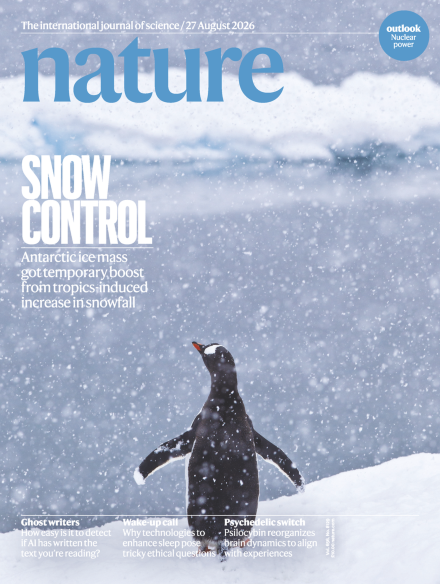
Snow control

For the past few decades, the Antarctic Ice Sheet has been steadily losing mass as a result of climate change. But between 2021 and 2023, something surprising happened: the rate of ice loss slowed dramatically, and East Antarctica actually gained a significant amount of ice mass. An explanation for this counterintuitive event is offered in this week’s issue by Qinghua Ding and colleagues. The researchers find that there is an atmospheric connection between the Antarctic and persistent warming of sea-surface temperatures in the tropical warm pool (an area of water in the Pacific and Indian Oceans). The abnormally warm tropical waters created a train of alternating high- and low-pressure areas in the atmosphere that propagated towards the pole. This induced a high-pressure anomaly over East Antarctica resulting in increased snowfall, which drove the rise in ice mass. However, the team notes that this mass gain is likely to be only temporary and that net ice loss will continue as the world warms.

Cover image: Klein & Hubert/Nature Picture Library.
This Week

Top of page ⤴

News in Focus

Top of page ⤴

Books & Arts

Top of page ⤴

Opinion

Top of page ⤴

Work

Top of page ⤴

Research

  • News & Views

  • Reviews

  • Articles

    • Analysis of tracking data from Mars orbiters reveals time-variable gravity field behaviour reflecting the structure underlying the Martian crustal dichotomy and indicates the preservation of a 200–400 °C thermal anomaly in the present-day mantle below the southern highlands.

      • Alexander Berne
      • Nicholas Wagner
      • Francis Nimmo
      Article Open Access
    • Quantum oscillation measurements map the g-wave altermagnetic order parameter in CrSb, establishing it as a prototypical unconventional magnet with momentum-dependent spin splitting.

      • Mengmeng Long
      • Theodore I. Weinberger
      • Alexander G. Eaton
      Article Open Access
    • In a self-assembled monolayer molecule with a donor–acceptor–donor structure, the electronic resonance increased the negative charge density at the acceptor-anchoring group, improving the certified efficiencies of rigid and flexible perovskite solar cells.

      • Xiaoxiao Wu
      • Wenwen Kou
      • Yongfang Li
      Article
    • A new method for practical scaling up of enzymatic thiophosphorylation is described, making use of a two-kinase system along with recycling of the very expensive ATPγS, providing a pathway for thiophosphate-containing modalities in drug development.

      • Xiangyu Wu
      • Yu Fu
      • Hans Renata
      Article
    • Global photovoltaic waste will reach 297–402 million tonnes by 2060, and regionally adapted recycling strategies and international cooperation will be needed to provide equitable and scalable PV waste circularity.

      • Chen Wang
      • Jian Zuo
      • Jiashuo Li
      Article Open Access
    • Recent Antarctic ice mass gain was linked to a recurrent atmospheric teleconnection, but this recurs about once per decade in observations and historical simulations so does not yet reflect a global-warming-driven moistening of Antarctica.

      • Yunhe Wang
      • Qinghua Ding
      • Eric J. Steig
      Article Open Access
    • An analysis of the relationships between aboveground biomass and various climatic factors in three major regions of tropical forest shows that understanding the complex interactions between climate, topography and soils is crucial to predict how climate change will affect carbon storage capacity.

      • Matheus Henrique Nunes
      • Helene C. Muller-Landau
      • Ralph Dubayah
      Article
    • The psychedelic psilocybin reorganizes brain activity into structured, context-aligned patterns that integrate internal and external processing, providing a neural basis for the felt continuity between self and world, elucidating how the psychedelic state translates into psychological change.

      • Devon Stoliker
      • Leonardo Novelli
      • Adeel Razi
      Article Open Access
    • Pharmacological screening and behavioural assays in ants identify two specific neuropeptides that have key and opposite effects in regulating brood care, and that link nutritional state to age-dependent changes in parenting behaviour.

      • Alexander Paul
      • Tomas Kay
      • Daniel J. C. Kronauer
      Article Open Access
    • A connectome of the brain and ventral nerve cord of an adult female fruit fly is reconstructed and annotated, providing an open resource that reveals neural control of behaviour to be distributed, parallel and embodied.

      • Alexander S. Bates
      • Jasper S. Phelps
      • Wei-Chung Allen Lee
      Article Open Access
    • Using the Global Burden of Disease Study data across Asian countries and territories, life expectancy trends and the effects of cause-specific mortality and risk factors on changes in these trends are analysed.

      • Jiseung Kang
      • Hyeon Jin Kim
      • Nicholas Steel
      Article
    • In senescent cells, mitochondria-derived acetyl-CoA promotes histone acetylation and increases chromatin accessibility at inflammatory gene loci. Inhibition of SLC25A1 attenuates these effects, underscoring the therapeutic potential of targeting mitochondrial metabolism and its epigenetic crosstalk to delay age-related functional decline.

      • Hélène Martini
      • Jodie Birch
      • João F. Passos

      Collection:

      Article Open Access
    • Renal cell carcinoma tumours containing tertiary lymphoid structures (TLSs) are enriched for exhausted CD8+ T cells, including tumour-specific clonotypes with stem-like progenitor features and reduced terminal exhaustion.

      • Alexander B. Afeyan
      • Adi Nagler
      • Catherine J. Wu
      Article
    • Intramucosal GPR15-guided regulatory CD8+ T lymphocytes—which are diminished by deleterious GPR15 genetic mutations in severe, early-onset disease or by cell deficiencies in sporadic ulcerative colitis and Crohn’s disease—restrain macrophage-driven inflammation and present new potential therapeutic avenues for inflammatory bowel disease.

      • Jing Cui
      • Zuojia Chen
      • Michael J. Lenardo
      Article Open Access
    • Integrated multi-omic profiling of glioblastoma reveals GPNMB as a shared antigen in tumour cells and the surrounding microenvironment, and GPNMB-targeted chimeric antigen receptor T cells demonstrate therapeutic activity in vitro and in animal models.

      • Neil Savage
      • Shan Grewal
      • Sheila K. Singh
      Article Open Access
    • TROP2 marks poor-prognosis colorectal cancer cells with fetal-like, therapy-resistant states, and therapeutic targeting of TROP2 with antibody–drug conjugates in combination with chemotherapy enhances treatment efficacy by modulating tumour cell plasticity and overcoming resistance.

      • Nuria Vaquero-Siguero
      • Nikolaos Georgakopoulos
      • Rene Jackstadt
      Article Open Access
    • Different RNA modifications elicit different translation elongation rates for in vitro transcribed mRNAs that result in disparate translation outputs and fidelity, as shown here for N4-acetylcytidine versus the industry standard for synthetic mRNAs, N1-methylpseudouridine.

      • Sarah Schiffers
      • Blake W. Nelson
      • Shalini Oberdoerffer
      Article Open Access
    • De novo design, combined with a high-throughput receptor-diversion microscopy-based screen, complementary display methods and functional assays, enabled the development of G-protein-coupled receptor-binding miniprotein agonists and antagonists targeting receptors implicated in itch, pain, cancer, metabolic disease and migraine.

      • Edin Muratspahić
      • David Feldman
      • David Baker
      Article
Top of page ⤴

Amendments & Corrections

Top of page ⤴

Nature Outlook

  • Few scientific phenomena have been associated with such an eerie blend of menace and promise as nuclear fission.

    Nature Outlook
Top of page ⤴
Nature Briefing

Sign up for the Nature Briefing newsletter — what matters in science, free to your inbox daily.

Get the most important science stories of the day, free in your inbox. Sign up for Nature Briefing

Search

Quick links