
This page is brought to you by Brian Golding (Golding@McMaster.CA) and is copied locally here to speed your access. To go to the original page (should you find something interesting or should you wish to follow links) click on

Current Issue of Nature


Volume 648 Issue 8093, 11 December 2025
Skip to main content

Thank you for visiting nature.com. You are using a browser version with limited support for CSS. To obtain the best experience, we recommend you use a more up to date browser (or turn off compatibility mode in Internet Explorer). In the meantime, to ensure continued support, we are displaying the site without styles and JavaScript.

Volume 648 Issue 8093, 11 December 2025

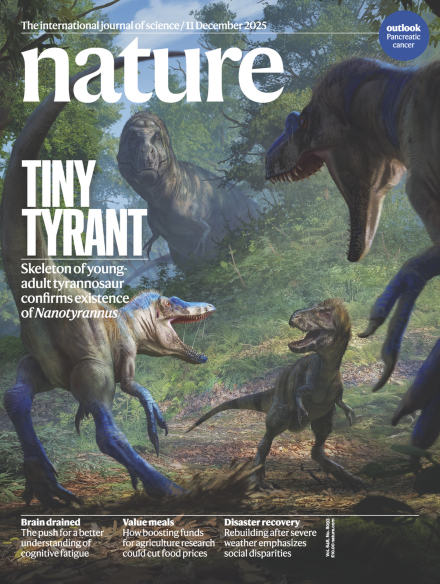
Tiny tyrant

Tyrannosaurus rex is one of the most iconic and well-known dinosaurs — but it has also been beset for decades by a controversy. At the heart of the debate is a fossil skull from what appeared to be a smaller cousin of T. rex, discovered in the 1940s. Initially described as a new species, Nanotyrannus lancensis, this skull has more recently been labelled as merely a juvenile Tyrannosaurus. In this week’s issue, Lindsay Zanno and James Napoli present evidence that should settle the debate. The authors describe a new skeleton of a small tyrannosaur found in the Hell Creek Formation in Montana. The remains are exceptionally well preserved, and the researchers were able to determine that it was a young adult — not yet fully grown, but also, crucially, unlikely to grow to anywhere near the size of an adult T. rex. Their analyses reveal that Nanotyrannus, a small, swift predator, hunted in the same ecosystems as the colossal apex predator T. rex at the end of the Cretaceous.

Cover image: Anthony Hutchings
This Week

  • Editorial

    • Advertisement

  • World View

Top of page ⤴

News in Focus

Top of page ⤴

Books & Arts

Top of page ⤴

Opinion

Top of page ⤴

Work

Top of page ⤴

Research

  • News & Views

  • Reviews

  • Articles

    • Laser-induced conversion electron Mössbauer spectroscopy, which detects electrons emitted by 229Th nuclei in a thin ThO2 sample excited by vacuum ultraviolet light, is demonstrated, opening the possibility of a conversion-electron-based nuclear clock.

      • Ricky Elwell
      • James E. S. Terhune
      • Eric R. Hudson
      Article Open Access
    • An autonomous method discovers reinforcement learning rules from the cumulative experiences of a population of agents across a large number of complex environments, and the discovered rule achieves state-of-the-art performance on challenging benchmarks.

      • Junhyuk Oh
      • Gregory Farquhar
      • David Silver
      Article Open Access
    • Ultralow-power ferroelectric field-effect transistors are used to achieve low-power NAND flash memory, overcoming the trade-off between multi-level capability and power efficiency and paving the way for next-generation storage memory.

      • Sijung Yoo
      • Taek Jung Kim
      • Duk-Hyun Choe
      Article
    • Experimental observations in small-grained polycrystals suggest a new concept of considering metallic grain boundaries not as defects but as separate defect-containing lattices, providing a potential explanation for the deformation behaviour of nanocrystalline metals.

      • Romain Gautier
      • Frédéric Mompiou
      • Marc Legros
      Article
    • A pooling–deconvolution algorithm identifies cooperative catalyst behaviours with low experimental cost while accommodating potential inhibitory effects between catalyst candidates.

      • Marcus H. Sak
      • Richard Y. Liu
      • Eric N. Jacobsen
      Article
    • A safe, versatile deaminative method converts aromatic amines into diverse C–X and C–C bonds via N-nitroamine intermediates, enabling broad one-pot cross-couplings without hazardous diazonium salts.

      • Guangliang Tu
      • Ke Xiao
      • Xiaheng Zhang
      Article Open Access
    • A well-preserved skeleton of a nearly mature tyrannosaur from the Hell Creek Formation in Montana, USA supports the existence of a second Nanotyrannus species, Nanotyrannus lethaeus sp. nov., and validates the recognition of Nanotyrannus as a genus separate from Tyrannosaurus.

      • Lindsay E. Zanno
      • James G. Napoli
      Article
    • Genomic sequencing of the thermotolerant coral species Oculina patagonica, single-cell transcriptomic analyses of symbiotic and non-symbiotic specimens and comparisons with obligate symbiotic coral species reveal adaptations that provide resilience to coral bleaching.

      • Shani Levy
      • Xavier Grau-Bové
      • Arnau Sebé-Pedrós
      Article
    • Coupling live-cell imaging, machine learning and genomic sequencing, the MAGIC platform enables investigation of the cellular context, mutation rates and triggers of spontaneous chromosomal abnormality formation, shedding light on fundamental determinants of chromosomal instability.

      • Marco Raffaele Cosenza
      • Alice Gaiatto
      • Jan O. Korbel
      Article Open Access
    • Human–artificial intelligence (AI) dialogues can meaningfully impact voters’ attitudes towards presidential candidates and policy, demonstrating the potential of conversational AI to influence political decision-making.

      • Hause Lin
      • Gabriela Czarnek
      • David G. Rand
      Article
    • Synthetic fibril strain 1B is a pathogen that is capable of self-replication and inducing glial cytoplasmic inclusions in vivo in mice, and the structural features of 1B may underlie the pathology of individuals with multiple-system atrophy.

      • Domenic Burger
      • Marianna Kashyrina
      • François Ichas
      Article Open Access
    • High-resolution rainfall, tide and mortaility data are used to quantify the impact of rainfall and flooding on urban health in Mumbai, India, revealing an order-of-magnitude discrepency between observed and officially reported mortality impacts, with slum residents bearing most of the burden.

      • Tom Bearpark
      • Ashwin Rode
      • Archana Patankar
      Article
    • An investigation of plant receptor-like kinases identifies regions of these proteins that control whether immune or symbiotic signalling pathways are activated, with minimal changes to specific residues in one of these regions being sufficient to alter signalling specificity.

      • Magdalini Tsitsikli
      • Bine Simonsen
      • Simona Radutoiu
      Article
    • Single-cell transcriptomic analyses of Plasmodium falciparum and Anopheles gambiae reveal key developmental stages, processes and factors in parasite–mosquito interactions and identify potential targets for blocking malaria transmission.

      • Yan Yan
      • Lisa H. Verzier
      • Flaminia Catteruccia
      Article Open Access
    • The fast skin-permeable polyzwitterion poly[2-(N-oxide-N,N-dimethylamino)ethyl methacrylate] may enable non-invasive transdermal delivery of insulin, and potentially facilitate the use of other protein- and peptide-based therapeutics through transdermal delivery.

      • Qiuyu Wei
      • Zhi He
      • Youqing Shen
      Article Open Access
    • A combined cryo-electron tomography and cryo-electron microscopy pipeline was developed to inflict axonal damage and monitor the cellular response induced by epothilone B, revealing that microtubule polymerization at and beyond the lesion site promote axon regeneration.

      • Satish Bodakuntla
      • Kenichiro Taira
      • Naoko Mizuno
      Article
Top of page ⤴

Amendments & Corrections

Top of page ⤴

Collections

  • Pancreatic cancer has long been a deadly and challenging disease. But researchers engaged in myriad efforts to tackle the cancer are beginning to have an effect — survival is up, and further positive change could be coming.

    Nature Outlook
  • Universities are under pressure, from declines in student numbers and government funding, to the proliferation of artificial intelligence in research and learning.

    Nature Index
Top of page ⤴
Nature Briefing

Sign up for the Nature Briefing newsletter — what matters in science, free to your inbox daily.

Get the most important science stories of the day, free in your inbox. Sign up for Nature Briefing

Search

Quick links