This page is brought to you by Brian Golding (Golding@McMaster.CA)
and is copied locally here to speed your access. To go to the
original page (should you find something interesting or should you
wish to follow links) click on
Thank you for visiting nature.com. You are using a browser version with limited support for CSS. To obtain
the best experience, we recommend you use a more up to date browser (or turn off compatibility mode in
Internet Explorer). In the meantime, to ensure continued support, we are displaying the site without styles
and JavaScript.
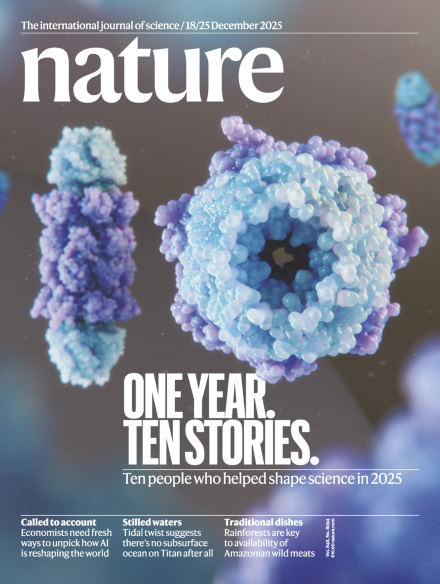
As the year 2025 draws to a close, we look back on the past 12 months through the lens of Nature’s 10 — ten people who helped to shape science during the year. This year, the cover is inspired by the proteasome, the cellular recycling system that led researchers to a previously unknown part of the human immune system. The one and zero in the cover’s ten are formed from the side and top-down views of the proteasome.
There were huge disruptions to the global scientific enterprise this year — but immense bright spots for health, discovery, innovation and research collaboration.
Having placed artificial intelligence at the centre of its own economic strategy, China is driving efforts to create an international system to govern the technology’s use.
A fired public-health official, a mosquito breeder and a baby with a smile seen around the world. These are just a few of the remarkable people chosen for Nature’s 10.
Controlled studies capture only a fraction of the effects of artificial intelligence. Economists should work with social scientists to find innovative ways to fully grasp this fast-moving field.
An assessment of the food hunted across the Amazon rainforest reveals its crucial role and how human pressures, particularly deforestation, threaten the resource.
Fossils newly discovered in Ethiopia indicate that previously unidentified foot bones belong to the ancient human relative Australopithecus deyiremeda.
Scientists discuss concerns that genetic manipulation could lead to disease outbreaks, and Nature is gifted an unusual scientific instrument, in our weekly dip into the archive.
Using genomic data, researchers have uncovered the origins and cultural practices of the people of Shimao, a 4,000-year-old fortified settlement in northern China.
Reanalysis of radiometric data from Cassini indicates that Titan does not contain a subsurface ocean, as strong tidal dissipation observed in its gravity field is not consistent with the presence of a liquid layer.
Gas-phase actinium monofluoride (AcF) has been produced and spectroscopically studied at the CERN-ISOLDE radioactive ion beam facility; the results highlight the potential of 227AcF for exceptionally sensitive searches of CP violation.
An 11-qubit atom processor comprising two precision-placed nuclear spin registers of phosphorus in silicon is shown to achieve state-of-the-art Bell-state fidelities of up to 99.5%.
An architecture inspired by Hopfield networks based on a programmable, stable, room-temperature optoelectronic oscillator-based photonics Ising machine is introduced that can be used to efficiently address optimization and combinatorics problems.
Scanning tunnelling microscopy is used to image pristine electrostatically defined quantum Hall edge states in graphene with high spatial resolution and demonstrate their interaction-driven restructuring.
A three-dimensional (3D) nanofabrication platform based on metalens-generated focal spot arrays is introduced to parallelize two-photon lithography beyond centimetre-scale write field areas, revealing the potential of 3D nanolithography towards wafer-scale production.
A modified Mn–PDP/HFIP catalyst that selectively oxidizes methylene C–H bonds in α,β-unsaturated carbonyl compounds is introduced; removing carboxylic acid additives and introducing HFIP suppresses undesired epoxidation with Mn-PDP, probably by promoting a more charged, chemoselective oxidation pathway.
Data provided by Amazonian peoples are used to estimate the value of wild animals as a source of food, including its spatial distribution and nutritional value, providing information that will be key for improved management of forest ecosystems in the region.
Discovery of a nearly complete skeleton of Huayracursor jaguensis, a Carnian dinosaur from the Northern Precordillera Basin in northwestern Argentina provides evidence of increased body size and early cervical elongation during the Late Triassic epoch.
A newly compiled atlas of species-wide structural variants and gene-based and graph pangenomes derived from highly complete assemblies of genomes from 1,086 natural isolates enable integrative genome-scale studies of Saccharomyces cerevisiae.
Sequencing of 144 ancient genomes from Shimao city and its satellites presents pedigrees among tomb owners spanning up to four generations showing predominantly patrilineal descent structure across Shimao communities, and possibly sex-specific sacrificial rituals.
Experiments with human volunteers and macaques show that expectations produced by probabilistic cueing of future sensory inputs shape motor circuit dynamics in order to increase the efficiency of movement responses.
NextBrain is an open source, probabilistic atlas of the entire human brain, assembled using artificial-intelligence-enabled registration and segmentation methods to reconstruct the multimodal serial histology of five human half brains, and which can be used to automatically segment brain MRI scans into 333 regions.
In flowering plants, DNA–FD–14-3-3 recruits FT to the florigen activation complex both through DNA–FT interactions and by reducing liquid phase condensation of FD protein, which promotes dimerization, leading to FT recruitment.
This multi-omic longitudinal analysis of the healthy human peripheral immune system constructs the Human Immune Health Atlas and assembles data on immune cell composition and state changes with age, including responses to cytomegalovirus infection and influenza vaccination.
Cellular Z-RNAs generated during active virus infections are bona fide ZBP1 ligands, and position ZBP1-activated cell death as a host response to counter viral disruption of the cellular transcriptional machinery.
Analysis of the longest-lived mammal, the bowhead whale, reveals an improved ability to repair DNA breaks, mediated by high levels of cold-inducible RNA-binding protein.
Results of an early-phase breast cancer prevention trial demonstrate the potential for breast cancer prevention in premenopausal women with anti-progestin therapy by inducing epithelial–stromal remodelling and suppression of luminal progenitors.
Structural studies of 16 native yeast ribosomal small subunit processome structures provide insights into the mechanisms governing the transformation into a pre-40S particle.
Structures of GDP-bound MOR–Gi conformational states combined with pharmacological assays show an inverse correlation between ligand efficacy and GDP affinity, where agonists decrease GDP affinity, promoting GTP exchange, and antagonists increase GDP affinity, dampening activation, thus providing structural and mechanistic insights into G protein activation.