
This page is brought to you by Brian Golding (Golding@McMaster.CA)
and is copied locally here to speed your access. To go to the
original page (should you find something interesting or should you
wish to follow links) click on
Thank you for visiting nature.com. You are using a browser version with limited support for CSS. To obtain
the best experience, we recommend you use a more up to date browser (or turn off compatibility mode in
Internet Explorer). In the meantime, to ensure continued support, we are displaying the site without styles
and JavaScript.
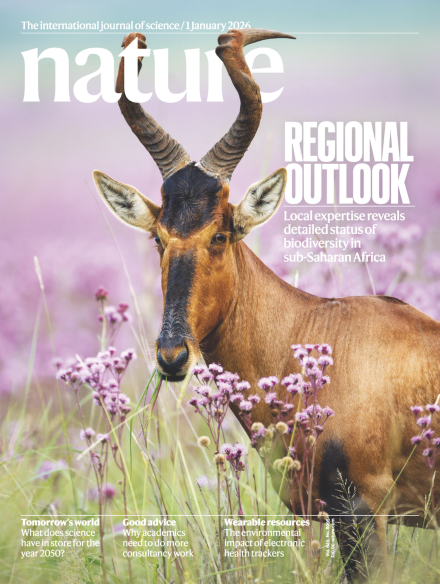
The cover captures a hartebeest (Alcelaphus buselaphus) in South Africa. Although maintaining biodiversity is core to sustainable development, policymakers frequently lack context-specific information on the state of biodiversity in a region to help guide their decisions. In this week’s issue, Hayley Clements and colleagues present an approach that could alleviate this situation. The researchers tapped into the place-based knowledge of 200 African biodiversity experts to perform a comprehensive survey of how intact sub-Saharan Africa’s biodiversity is. They found that the region has lost an average of 24% of its pre-industrial faunal and floral abundances. With less than 55% extant, Rwanda and Nigeria were the least intact, whereas Namibia and Botswana, at around 85%, were the most intact. The team notes that most of the remaining organisms are found in unprotected rangelands and natural forests where people co-exist with and depend on nature, which suggests that inclusive conservation approaches could prove beneficial.
Cover image: Richard Du Toit/Nature Picture Library.
The COVID-19 pandemic, Ebola, mpox and AIDS all show the importance of strengthening Africa-wide surveillance and response systems that protect everyone.
The rise of AI scientists, missions to explore the moons of Earth and Mars and a massive ocean-floor drill are among the developments set to shape research in 2026.
If you’ve hatched a New Year plan to move abroad, improve your presentations or chase happiness as a 20-something researcher, you’ll find advice aplenty in these books.
A stem-cell-based monkey embryo model that self-organizes into a comprehensive body plan could lead the way to more-sophisticated models of early human development.
As the giants of the animal kingdom dwindle in numbers, a new way to assess ecosystem function sheds light on animals’ changing ecological contributions.
How circular extrachromosomal DNA is inherited during cell division is a puzzle. Key sequences enabling this DNA to journey with chromosomes have been identified.
Reconfigurable arrays of up to 448 neutral atoms are used to implement and combine the key elements of a universal, fault-tolerant quantum processing architecture and experimentally explore their underlying working mechanisms.
Fermionic currents of opposing chirality can be spatially filtered without the need for a magnetic field using the quantum geometry of topological bands in single-crystal PdGa.
Stacking perovskite LEDs in tandem structures to combine the luminance of individual units yielded efficiencies greater than the summed efficiencies of equivalent single-unit devices, suggested to result from photon recycling between individual light-emitting elements.
A certified flexible perovskite/crystalline silicon tandem solar cell has efficiencies rivalling its rigid counterparts and demonstrates exceptional mechanical robustness and stability.
A flexible perovskite/silicon tandem solar cell making use of a dual-buffer layer comprising a compact SnOx layer deposited first followed by a loose SnOx layer is described, showing efficiencies rivalling rigid counterparts and good durability.
An integrated systems engineering framework based on life-cycle inventories is used to quantify the global eco-footprint of wearable healthcare electronics and identify effective mitigation strategies.
An aryne precursor is designed to overcome the lack of widespread adoption of arynes due to the undesirable means to generate them and harness their synthetic potential that rivals most functional groups.
A re-assessment of the global carbon budget shows the natural land sink is substantially smaller than previously estimated, indicating emerging impacts of climate change on the evolution of the carbon sinks.
An ecosystem energetics approach, quantifying trophic energy flows across species, offers a unified framework for linking animal biodiversity loss to changes in ecosystem function and Earth system processes.
Regional, place-based biodiversity information is used to comprehensively map and quantify biodiversity intactness of sub-Saharan Africa to inform national and global sustainability policies and planning.
A pangenome of oat, assembled from 33 wild and domesticated oat lines, sheds light on the evolution and genetic diversity of this cereal crop and will aid genomics-assisted breeding to improve productivity and sustainability.
The human superior temporal gyrus processes acoustic–phonetic properties of speech regardless of whether the language is familiar to the listener, but only encodes word boundaries and language-specific sound sequences if the language is known.
A combination of genome-wide functional screening, imaging and chromatin profiling identifies a new class of highly prevalent genomic elements that help retain extrachromosomal DNA copies in dividing cells and persist across generations.
An optimized 3D culture system enabled a stem cell-derived monkey blastoid to develop to day 25, recapitulating key events of primate late gastrula and demonstrating notable similarity to natural embryos.
The combination of computational design, laboratory-based screening and biophysical validation enables the de novo generation of variable heavy-chain antibody fragments and antibodies that precisely target chosen disease-related molecules.
PD-1 blockade interferes with the selective expansion and maintenance of high-affinity TCR stem-like clones that have a critical role in effective checkpoint blockade therapy.
A highly potent and selective small-molecule catalytic inhibitor of the protein lysine methyltransferase NSD2 shows therapeutic efficacy in preclinical models of KRAS-driven pancreatic cancer and lung cancer.
Inhibition of the histone methyltransferase NSD2 and the androgen receptor in preclinical models can reverse lineage plasticity to suppress tumour growth and promote cell death in multiple subtypes of castration-resistant prostate cancer.
Live-cell imaging of mRNA encoding secretome proteins and translated nascent peptide markers show that secretome translation occurs at endoplasmic reticulum junctions near lysosomes, requires lunapark protein and is modulated by nutrient status.
A hybrid machine learning and atomistic modelling strategy enables one-shot design of efficient enzymes to catalyse diverse biological and non-biological chemical transformations.
A generative artificial intelligence-powered method enables de novo design of highly active enzymes based on information about the geometry of residues in the active site, without requiring protein backbone or sequence information.