
This page is brought to you by Brian Golding (Golding@McMaster.CA) and is copied locally here to speed your access. To go to the original page (should you find something interesting or should you wish to follow links) click on

Current Issue of Nature


Volume 650 Issue 8100, 5 February 2026
Skip to main content

Thank you for visiting nature.com. You are using a browser version with limited support for CSS. To obtain the best experience, we recommend you use a more up to date browser (or turn off compatibility mode in Internet Explorer). In the meantime, to ensure continued support, we are displaying the site without styles and JavaScript.

Volume 650 Issue 8100, 5 February 2026

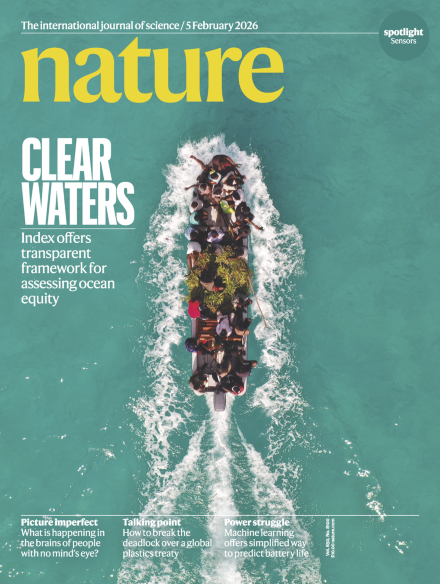
Clear waters

The cover shows members of a local community in the Western Province of the Solomon Islands taking part in a traditional fish drive, in which multiple members of a community work together to make the catch. The world’s oceans and their resources are crucial to humanity, but there is increasing inequity when it comes to accessing these resources. The benefits tend to be accrued by the powerful, whereas the burdens — from pollution to biodiversity loss — are more often shouldered by the most vulnerable. Many of these vulnerable groups, such as Indigenous peoples and small-scale fishers, are also excluded from the decision-making processes and a fair share in ocean benefits. In this week’s issue, Jessica Blythe, Joachim Claudet, David Gill and colleagues present the Ocean Equity Index — a framework for advancing equity. Consisting of 12 criteria, the index offers a transparent and standardized way to assess and monitor equity in ocean initiatives, projects and policies. The researchers hope that the index will improve the way equity is incorporated into ocean initiatives and so pave the way to better outcomes for coastal people and marine ecosystems.

Cover image: Alec Hughes/WCS.
This Week

Top of page ⤴

News in Focus

Top of page ⤴

Books & Arts

  • Book Review

    • Social media can help to raise awareness of health conditions — but the wealth of dubious information online might do more harm than good.

      • Helen Pearson
      Book Review
Top of page ⤴

Opinion

Top of page ⤴

Work

Top of page ⤴

Research

  • News & Views

  • Reviews

  • Articles

    • First-principles molecular dynamics driven by density functional theory is used to show that silicate and hydrogen are completely miscible over a wide range of plausible core–envelope pressure–temperature conditions.

      • Travis Gilmore
      • Lars Stixrude
      Article Open Access
    • The STAR experiment at the Relativistic Heavy Ion Collider at Brookhaven National Laboratory demonstrates evidence of spin correlations in \(\Lambda \bar{\Lambda }\) hyperon pairs inherited from virtual spin-correlated strange quark–antiquark pairs during QCD confinement.

      • B. E. Aboona
      • J. Adam
      • M. Zyzak
      Article Open Access
    • The nuclear clock transition of 229mTh in 229Th:CaF2 crystals is characterized as a function of doping concentration, temperature and time, demonstrating high reproducibility and identifying ideal operating characteristics of these crystals as nuclear clocks.

      • Tian Ooi
      • Jack F. Doyle
      • Thorsten Schumm
      Article
    • Lasing with multi-pass gain is achieved in a diamond-based X-ray cavity at the European XFEL, opening a path to next-generation X-ray science.

      • Patrick Rauer
      • Immo Bahns
      • Harald Sinn
      Article Open Access
    • The fluorooxoborate crystal NH4B4O6F shows promise as a nonlinear optical material for vacuum ultraviolet light sources through second-harmonic generation, demonstrating record output energy and efficiency resulting from optimized arrangements of fluorine-based units creating asymmetric sublattices.

      • Fangfang Zhang
      • Zilong Chen
      • Shilie Pan
      Article
    • Fibre integrated circuits created by first preparing circuitry on extremely thin and flexible substrates and then mechanically rolling them up demonstrate microdevice density reaching 100,000 transistors per centimetre and excellent stability under harsh service conditions.

      • Zhen Wang
      • Ke Chen
      • Huisheng Peng
      Article
    • Discovery Learning, a machine learning approach integrating active learning, physics-guided learning and zero-shot learning into a human-like reasoning loop, is described for predicting the battery cycle life of new designs from minimal experiments, reducing prototyping requirements.

      • Jiawei Zhang
      • Yifei Zhang
      • Ziyou Song
      Article
    • During the Last Glacial Maximum, the deep Northwest Atlantic was only about 2 °C colder than today, suggesting sustained production of relatively warm North Atlantic Deep Water during the Last Glacial Maximum.

      • Jack H. Wharton
      • Emilia Kozikowska
      • David J. R. Thornalley
      Article Open Access
    • The Ocean Equity Index provides a systematic, twelve-criteria framework to assess and improve equity in ocean initiatives, projects and policies, producing structured data that guide evidence-based decisions and support more equitable outcomes for coastal communities and ecosystems.

      • Jessica L. Blythe
      • Joachim Claudet
      • Noelia Zafra-Calvo
      Article Open Access
    • Analysis of eukaryotic gene sequences using a relaxed molecular clock methodology indicate that eukaryotes emerged 3.0–2.25 billion years ago as a result of mitochondrial endosymbiosis with complex archaea that already possessed an elaborated cytoskeleton, membrane trafficking, endomembrane, phagocytotic machinery and a nucleus.

      • Christopher J. Kay
      • Anja Spang
      • Philip C. J. Donoghue
      Article Open Access
    • A survey of the reconstructed gene set of the last eukaryotic common ancestor shows a consistent link between Asgard archaea and the origin of numerous, functionally diverse eukaryotic genes, demonstrating the dominant Asgard contribution to eukaryogenesis.

      • Victor Tobiasson
      • Jacob Luo
      • Eugene V. Koonin
      Article Open Access
    • Early vertebrates, particularly myllokunmingids, possessed four camera-type eyes (a pair of lateral eyes and pineal and parapineal organs), which indicates that these structures functioned in image formation, in support of the hypothesis that the four camera-type eyes represent an ancestral vertebrate trait.

      • Xiangtong Lei
      • Sihang Zhang
      • Xing Xu
      Article
    • A mode of brain organization that connects visual and bodily reference frames may translate raw sensory impressions into more abstract formats that are useful for action, social cognition and semantic processing.

      • Nicholas Hedger
      • Thomas Naselaris
      • Tomas Knapen
      Article Open Access
    • Immune features and T cell characteristics that correlate with post-intervention control of HIV-1 viraemia inform the development of combination immunotherapies that may enhance the ability to elicit durable HIV remission.

      • Zahra Kiani
      • Jonathan M. Urbach
      • David R. Collins
      Article Open Access
    • Together with a companion paper, molecular details of immune responses in a pig-to-human xenotransplantation are identified through dense longitudinal multi-omics profiling of the xenograft and the host recipient, across the 61-day procedure.

      • Eloi Schmauch
      • Brian D. Piening
      • Brendan J. Keating
      Article
    • Xenotransplantation of a genetically edited pig kidney with a thymic autograft into a brain-dead human for 61 days with immunosuppression resulted in stable kidney function without proteinuria, and xenograft rejection was treated and reversed by the end of the study.

      • Robert A. Montgomery
      • Jeffrey M. Stern
      • Megan Sykes
      Article
    • An intestinal organoid model recapitulates human microfold (M) cell function and transcriptomic profiling and biochemical assays demonstrate that M cells uptake and present antigens to the immune system via the class II major histocompatibility complex.

      • Daisong Wang
      • Sangho Lim
      • Hans Clevers
      Article Open Access
Top of page ⤴

Amendments & Corrections

Top of page ⤴

Spotlight

  • A new wave of sensors is revolutionising how we work and live.

    Spotlight
Top of page ⤴
Nature Briefing

Sign up for the Nature Briefing newsletter — what matters in science, free to your inbox daily.

Get the most important science stories of the day, free in your inbox. Sign up for Nature Briefing

Search

Quick links