
This page is brought to you by Brian Golding (Golding@McMaster.CA) and is copied locally here to speed your access. To go to the original page (should you find something interesting or should you wish to follow links) click on

Current Issue of Nature


Volume 650 Issue 8101, 12 February 2026
Skip to main content

Thank you for visiting nature.com. You are using a browser version with limited support for CSS. To obtain the best experience, we recommend you use a more up to date browser (or turn off compatibility mode in Internet Explorer). In the meantime, to ensure continued support, we are displaying the site without styles and JavaScript.

Volume 650 Issue 8101, 12 February 2026

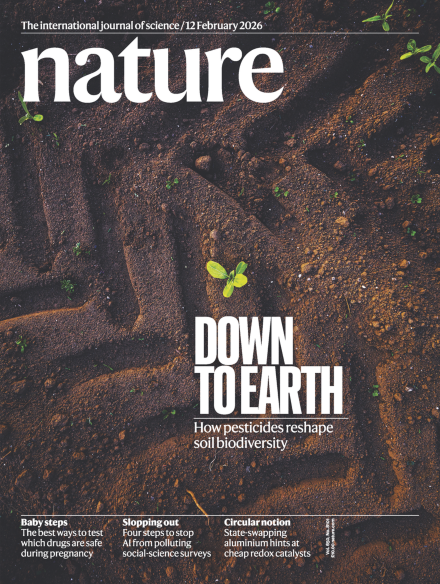
Down to earth

The use of synthetic pesticides is widespread, and their potentially harmful effects on wildlife — from bees to fish— and human health are well documented. Somewhat less clear are their effects on soil biodiversity. In this week’s issue, Marcel van der Heijden and colleagues address this issue with a report on how pesticide residues affect soils across Europe. The researchers assessed 63 pesticides across 373 sites in 26 European countries. Pesticide residues were present at 70% of the sites and showed the second biggest effect on soil biodiversity patterns after soil properties. The team also saw specific patterns, with pesticides altering microbial functions and suppressing beneficial organisms, suggesting that functional and taxonomic characteristics need to be part of risk assessments for preserving soil biodiversity.

Cover image: Daniele Orsi/ REDA/Universal Images Group/Getty.
This Week

Top of page ⤴

News in Focus

Top of page ⤴

Books & Arts

Top of page ⤴

Opinion

Top of page ⤴

Work

Top of page ⤴

Research

  • News & Views

  • Articles

    • Amplification and optimal noise filtering in hyperpolarized noble-gas spins of observations from distributed intercity quantum sensors monitoring for unexpected transient rotations of polarized spins set parameter range constraints in the search for axion dark matter.

      • Yuanhong Wang
      • Ying Huang
      • Jiangfeng Du
      Article
    • Emu3 enables large-scale text, image and video learning based solely on next-token prediction, matching the generation and perception performance of task-specific methods, with implications for the development of scalable and unified multimodal intelligence systems.

      • Xinlong Wang
      • Yufeng Cui
      • Tiejun Huang
      Article Open Access
    • A measurement strategy is described that is able to read out the parity of minimal two-site Kitaev chains in real time, by coupling two Majoranas and resolving their quantum capacitance.

      • Nick van Loo
      • Francesco Zatelli
      • Leo P. Kouwenhoven
      Article
    • CrPS4, a 2D van der Waals A-type antiferromagnet, is shown to exhibit ideal characteristics of Stoner–Wohlfarth antiferromagnets, such as ferromagnet-like binary switching rather than layer-by-layer flipping as in other 2D A-type antiferromagnets.

      • Zhanshan Wang
      • Yining Xiang
      • Shiwei Wu
      Article Open Access
    • Using a wafer-scale monolayer 2D MoS2 process instead of conventional silicon-based devices to manufacture components of spaceborne communication systems demonstrates radiation tolerance, low bit error rate and long-term stability, even under much harsher radiation environments.

      • Liyuan Zhu
      • Yang Yang
      • Peng Zhou
      Article
    • Large-scale molecular dynamics simulations show that the crystal–melt interfacial energies of MgSiO3 bridgmanite increase substantially with pressure, potentially forming unusually large bridgmanite crystals and suggesting a new physical mechanism driving magma ocean segregation.

      • Jie Deng
      • Junwei Hu
      • Lars Stixrude
      Article
    • With its attribution to Paranthropus, a 2.6-million-year-old partial mandible expands the range of the genus into the Afar region of Ethiopia and adds to our understanding of hominin evolution in eastern Africa.

      • Zeresenay Alemseged
      • Fred Spoor
      • Jonathan G. Wynn
      Article
    • Yakut communities, with Trans-Baikal admixture during the Mongol expansion, preserved genomic diversity and oral microbiomes despite the Russian conquest, which introduced cereals, pathogens and Christianity, whereas marital practices preserved low consanguinity except in one late case of traditional shamanism.

      • Éric Crubézy
      • Perle Guarino-Vignon
      • Ludovic Orlando
      Article Open Access
    • A detailed spatiotemporal roadmap of the human female and male reproductive tracts during key periods of sexual differentiation provides new cellular and molecular insights into how early axial gradients lead to specific cell lineages and tissue structures.

      • Valentina Lorenzi
      • Cecilia Icoresi-Mazzeo
      • Roser Vento-Tormo
      Article Open Access
    • Hepatocyte organoids derived directly from human tissue enable long-term hepatocyte expansion and can be combined with portal mesenchyme and cholangiocyte organoids to form a donor-specific periportal liver assembloid system.

      • Lei Yuan
      • Sagarika Dawka
      • Meritxell Huch
      Article Open Access
    • Comprehensive large-scale studies of multi-national populations identified microbiome species consistently associated with favourable and unfavourable health markers, informing future studies of the human gut microbiome and its association with diet and cardiometabolic conditions.

      • Francesco Asnicar
      • Paolo Manghi
      • Nicola Segata
      Article Open Access
    • The tolerogenic activity of type 1 conventional dendritic cells (cDC1s) is determined by EPOR, which is preferentially expressed in cDC1s and induces antigen-specific FOXP3-expressing regulatory T cells.

      • Xiangyue Zhang
      • Christopher S. McGinnis
      • Edgar G. Engleman
      Article
    • One-shot tissue dynamics reconstruction can infer changes in tissue composition over time, from single-time-point spatial proteomics of human cancers.

      • Jonathan Somer
      • Shie Mannor
      • Uri Alon
      Article Open Access
    • Mu opioid receptor agonists with a preference for the non-GTP-bound state of the G protein promote GTP release, thereby potentiating antinociceptive effects of drugs such as morphine and fentanyl without also increasing their respiratory or cardiac effects.

      • Edward L. Stahl
      • Matthew A. Swanson
      • Laura M. Bohn
      Article Open Access
Top of page ⤴

Amendments & Corrections

Top of page ⤴
Nature Briefing

Sign up for the Nature Briefing newsletter — what matters in science, free to your inbox daily.

Get the most important science stories of the day, free in your inbox. Sign up for Nature Briefing

Search

Quick links