This page is brought to you by Brian Golding (Golding@McMaster.CA)
and is copied locally here to speed your access. To go to the
original page (should you find something interesting or should you
wish to follow links) click on
Thank you for visiting nature.com. You are using a browser version with limited support for CSS. To obtain
the best experience, we recommend you use a more up to date browser (or turn off compatibility mode in
Internet Explorer). In the meantime, to ensure continued support, we are displaying the site without styles
and JavaScript.
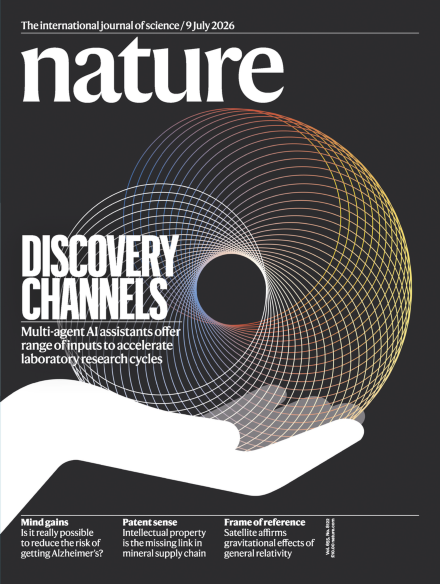
Scientific discovery is essentially an iterative process, following the cycle of generating a hypothesis, designing an experiment to test that hypothesis and analysing the data collected. A key limiting factor in this process, especially in today’s increasingly multidisciplinary research landscape, is the depth and breadth of knowledge researchers can bring to bear on a given problem — people can only read so fast and assimilate so much. Two papers in this week’s issue present independent multi-agent AI systems aimed at helping researchers speed up the laboratory research cycle. Both systems can generate hypotheses, propose experiments to test their ideas, interpret the experimental results and then refine hypotheses on the basis of the data. Google DeepMind built its lab assistant, called Co-Scientist, with the large language model Gemini 2.0 and used it to seek out potential drug candidates to treat acute myeloid leukaemia. FutureHouse created its assistant, known as Robin, using OpenAI o4-mini and Anthropic Claude 3.7. It, too, was also designed to aid drug discovery, in this case potential treatments for dry age-related macular degeneration. Both teams emphasize that their systems are designed to collaborate with researchers, with human scientists remaining in control.
Depletion of the ozone layer has been traced mainly to the widespread use of industrial chlorofluorocarbon chemicals, but there might have been an additional culprit.
Coffee plants are critically endangered by climate change. Researchers are finding solutions to keep scientists supplied with their favourite discovery fuel.
A biology journal that paid peer reviewers found that the approach cut the time to a first editorial decision by 85% and maintained high-quality reviews.
With the far-right Alternative for Germany leading in polls for national and state elections, institutions are facing up to proposed restrictions on academic freedom.
Soil bacteria make cocktails of molecules that synergistically inhibit the growth of microbial pathogens — suggesting a strategy for tackling antibiotic-resistant infections.
Direct imaging shows that the contacts through which current flows into atomically thin transistors can be scaled down to just a few nanometres in length.
A surge of genetic data from the skeletal remains of Neanderthals disproves some assumptions and generates fresh questions about these ancient hominins.
The first solidification of the second-lightest element, and evidence of an ancient salt-water lake in Peru, in this week’s pick from the Nature archive.
This Review examines the opportunities and challenges introduced by new datasets and computational techniques in urban crime research, and outlines future directions for leveraging these advances effectively.
Using the parameter-free Angular Distribution of Pairwise Distances for measuring directional correlations, evidence is found for coherent anisotropic structures extending over gigaparsec scales, challenging the assumption that the Universe becomes statistically isotropic on sufficiently large scales.
Using LARES-2, LAGEOS and GRACE satellites, researchers measured Earth’s frame-dragging with unprecedented precision, strongly confirming general relativity, constraining alternative gravity theories, and improving measurements of Earth’s tides.
By using a fibre-optical analogue of the physics of black holes, theoretical and experimental evidence is presented for the process underpinning the generation of Hawking radiation and its backreaction onto the optical pump.
A volatile-assisted coordination strategy regulates surface defect chemistry and self-doping, thus stabilizing the stoichiometry of tin perovskite semiconductors, resulting in transistors that can maintain stable operation for a month at temperatures of 100 °C.
Visualization of concentration-driven phase segregation within high-concentration interfacial layers in the context of high-energy lithium–sulfur batteries using liquid-cell electrochemical transmission electron microscopy reveals competitive interfacial reactions under lean electrolyte conditions at different phase boundaries.
Viscoelastic phase separation is used to fabricate non-collapsible, air-rich networks in high-water-content hydrogels containing silica aerogel beads, allowing air to permeate through the material and enabling a tenfold increase in oxygen permeability over pristine hydrogels.
Chiral catalysts for hydrogen atom transfer are produced through a self-assembly mechanism that enables access to novel catalyst permutations, with applications including photochemical deracemization of 2-aryl pyrrolidines for use as pharmaceutical scaffolds.
New high-precision neodymium isotope data measured on recently erupted lavas from the submarine Fani Maoré volcano in the Comoros archipelago allow the identification of heterogeneities dating back to Earth’s earliest history.
Single-cell transcriptomics combined with morphological and ecological data show that the rapid evolutionary radiation of cichlid fishes in Lake Tanganyika was accompanied by dietary specialization across multiple layers of biological organization.
Genetic sequencing of multiple late Neanderthals living less than 52,500 years ago provides an overview of genetic diversity and demonstrates that even low-coverage nuclear genome data can increase resolution of within-Neanderthal diversity.
PTCHD1-AS, which encodes a long non-coding RNA, is associated with the aetiology of autism spectrum disorder in humans through striatal molecular and circuit-level dysregulation.
Systems-level analyses of organ intrinsic nervous systems reveal that these networks are initially configured by lineage-dependent programmes, and their architecture and molecular identity are refined by intra-organ specific local cues.
High-throughput barcoded neuroanatomy of two closely related rodent species with divergent vocalizations reveals differences in long-range projection motifs in the brain that may support these differences in vocal complexity.
Reparative microglia persist in the brain after stroke but become dysfunctional through ZFP384-mediated mechanisms; however, this process can be mitigated by targeting Zfp384 using therapeutic antisense oligonucleotides.
Using xenograft inflammation–recovery models and single-cell multiomics, a haematopoietic stem cell population after inflammatory stress is identified.
A fungal long non-coding RNA from Magnaporthe oryzae translocates into rice cells to sequester a host microRNA that normally represses PKR1, a negative immunity regulator, thereby facilitating infection and revealing a widespread RNA-based pathogen–host interaction mechanism.
In Streptomyces spp., a conserved biosynthetic gene megacluster produces an arsenal of distinct antimicrobials that converge on bacterial biotin biosynthesis as a naturally evolved combination therapy.
Integration of ubiquitin clippases with sortase-based labelling and mass spectrometry reveals that a wide range of non-peptide molecules are ubiquitinated in vivo, and points to a potential role for ubiquitination in physiological glycogen breakdown.
High-resolution in situ cryo-electron tomography in Schizosaccharomyces pombe identifies SNOR protein, which binds to ribosomes during dormancy induced by glucose depletion, priming them for rapid reactivation of protein synthesis upon glucose repletion.