
This page is brought to you by Brian Golding (Golding@McMaster.CA) and is copied locally here to speed your access. To go to the original page (should you find something interesting or should you wish to follow links) click on

Current Issue of Nature


Volume 655 Issue 8124, 23 July 2026
Skip to main content

Thank you for visiting nature.com. You are using a browser version with limited support for CSS. To obtain the best experience, we recommend you use a more up to date browser (or turn off compatibility mode in Internet Explorer). In the meantime, to ensure continued support, we are displaying the site without styles and JavaScript.

Volume 655 Issue 8124, 23 July 2026

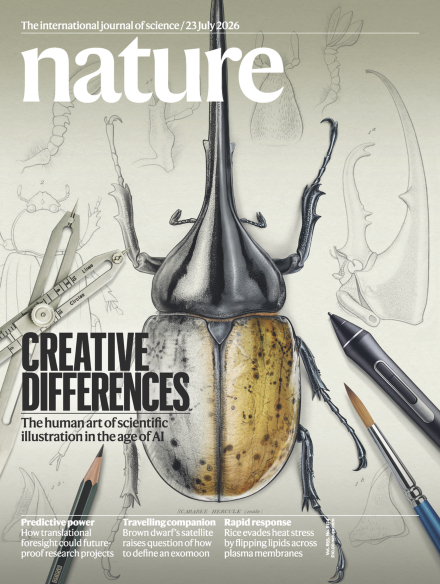
Creative differences

The cover image captures the creative journey that underpins the production of a scientific illustration. Brought to life by Nature Art Editor Richard Tibbitts, the cover reveals the key stages — from initial pencil sketch to intricate ink work to full-colour rendering — that went into this image of a rhinoceros beetle. It reflects the qualities that have made scientific illustration an essential tool for discovery and communication for centuries — close observation, expert knowledge and human judgement. In this week’s issue, we celebrate the craft of scientific illustration and examine the potential effects of artificial intelligence on this crucial aid to understanding. In a Books & Arts article, five illustrators discuss their craft and probe the limits of AI. A Technology Feature examines how judicious use of AI might help time-pressed labs create visual aids to explain their research. And an Editorial takes a look at how Nature front covers have evolved to tell the story of research papers over the years.

Cover image: Richard Tibbitts/Nature
This Week

Top of page ⤴

News in Focus

Top of page ⤴

Books & Arts

Top of page ⤴

Opinion

Top of page ⤴

Work

Top of page ⤴

Research

  • News & Views

  • Registered Report

  • Articles

    • Carbon isotopic measurements of the interstellar comet 3I/ATLAS reveal that it may have formed as long ago as 12 billion years and thus represents a preserved fragment of an ancient planetary system.

      • Martin Cordiner
      • Nathan X. Roth
      • Cristina A. Thomas
      Article Open Access
    • By integrating reinforcement learning with quantum error correction, a quantum computer continuously self-calibrates during computation, achieving record logical error rates and enhanced resilience to drift.

      • Volodymyr Sivak
      • Alexis Morvan
      • Paul V. Klimov
      Article Open Access
    • A new class of materials, quantum statistical plasmonic metacrystals, is described, which can selectively transmit different types of light based only on their quantum coherence, showing bands of allowed and forbidden photon statistics.

      • Chenglong You
      • Riley B. Dawkins
      • Omar S. Magaña-Loaiza
      Article Open Access
    • Radio-frequency switches made from two-dimensional layered hexagonal boron nitride (hBN) were co-integrated on gallium nitride (GaN) microchips to build programmable millimetre-wave (mmWave) monolithic microwave integrated circuits suitable for 6G hardware.

      • Sebastian Pazos
      • Andrés Fontana
      • Mario Lanza
      Article
    • A catalyst-free upcycling strategy based on in situ generation of hydroxyl radicals at microdroplet interfaces is described for efficient and scalable processing of polymers with minimal infrastructure, using only water and oxygen under mild conditions.

      • Ruiliang Gao
      • Liwei Zhang
      • Yong Wang
      Article Open Access
    • Satellite imagery and machine learning used for the mapping of six seminatural open wetland types and land-use disturbance in European countries shows that wetlands are highly fragmented and have uneven restoration needs.

      • Gyula Mate Kovács
      • Xiaoye Tong
      • Rasmus Fensholt
      Article Open Access
    • Trait-based ecosystem modelling shows that impact-driven darkness and body-size-dependent extinction thresholds, rather than carbon-dioxide increase or acidification, drove most of the observed end-Cretaceous marine extinction patterns.

      • Rui Ying
      • Fanny M. Monteiro
      • Daniela N. Schmidt
      Article Open Access
    • Experiments using the comb jelly Mnemiopsis leidyi and the sea anemone Nematostella vectensis reveal that the emergence of a core signalling pathway may have been a key innovation enabling the transition to multicellularity in animals.

      • Stanislav Kremnyov
      • Tatiana Lebedeva
      • Andreas Hejnol
      Article Open Access
    • A genome-wide association study combining data from the Estonian Biobank and the UK Biobank identifies many common and low-frequency locus–metabolic trait associations, enabling the identification of putative causal links with disease outcomes.

      • Ralf Tambets
      • Mihkel Jesse
      • Priit Palta
      Article Open Access
    • Integration of data representing 35,120 brain scans from diverse global studies enables construction of reference charts that define normative microstructural and macrostructural properties across the human lifespan for research and clinical diagnosis.

      • Michael E. Kim
      • Chenyu Gao
      • Kurt G. Schilling
      Article Open Access
    • Basic properties of symmetric random matrices can explain the emergence of macroscopic patterns in neural networks, suggesting that initialization conditions of connected neural populations may confer computational advantages across the mouse brain.

      • Marius Pachitariu
      • Lin Zhong
      • Carsen Stringer
      Article Open Access
    • Combining a computational framework and optogenetic and chemogenetic manipulations within and downstream of the cortico-basal ganglia circuit identifies the specific cortico-basal ganglia synapses that drive the acquisition and expression of rapid vocal changes during juvenile song learning.

      • Drew C. Schreiner
      • Samuel Brudner
      • Richard Mooney
      Article
    • Longitudinal transcriptomic, chromatin and genomic analyses of the two types of IDH-mutant glioma reveal in detail how disease progression is influenced by interdependent genetic, epigenetic and microenvironmental factors.

      • Kevin C. Johnson
      • Avishay Spitzer
      • Roel G. W. Verhaak
      Article Open Access
Top of page ⤴

Amendments & Corrections

Top of page ⤴
Nature Briefing

Sign up for the Nature Briefing newsletter — what matters in science, free to your inbox daily.

Get the most important science stories of the day, free in your inbox. Sign up for Nature Briefing

Search

Quick links