
This page is brought to you by Brian Golding (Golding@McMaster.CA) and is copied locally here to speed your access. To go to the original page (should you find something interesting or should you wish to follow links) click on

Current Issue of Nature


Volume 655 Issue 8125, 30 July 2026
Skip to main content

Thank you for visiting nature.com. You are using a browser version with limited support for CSS. To obtain the best experience, we recommend you use a more up to date browser (or turn off compatibility mode in Internet Explorer). In the meantime, to ensure continued support, we are displaying the site without styles and JavaScript.

Volume 655 Issue 8125, 30 July 2026

Quantum silicon

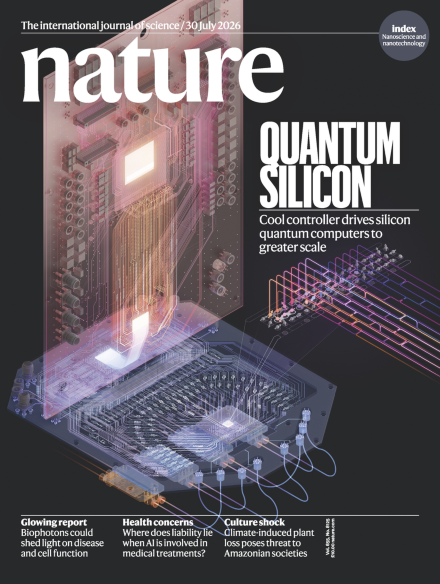
Silicon microchips are the beating heart of modern computers. If they could also be used for chips in a quantum computer, that would be a potential path to scalable commercial quantum machines. But to date, the development of silicon-qubit-based systems has been difficult. A key challenge for all cryogenic quantum systems is that the electronic control circuitry sits at room temperature and the wiring needed to connect it to the qubits has to bridge a temperature difference of some 300 kelvin, limiting how large the system can grow. In this week’s issue, the HRL Quantum Team and Collaborators present a much larger and more integrated silicon-based quantum-computing platform than previously seen. Their quantum processor is connected by superconducting wires to a control chip that operates at only 4 kelvin. The system ran repeated rounds of error correction autonomously, suggesting the control architecture could be used in much larger systems. The set-up is captured on the cover: the motherboard with the 4 K cryo-controller is vertical and shown in orange, the cooler daughterboard holding the qubit chip, which runs at the millikelvin level, is blue and purple, with the superconducting cable between them in white. A second paper in this issue by Brennan Undseth and colleagues also tackles the issue of silicon-based qubits, this time enabling a mobile qubit to shuttle between four stationary qubits, allowing the team’s set-up to perform parity-check measurements that are at the core of quantum error correction.

Cover image: John Carpenter/HRL Laboratories.
This Week

Top of page ⤴

News in Focus

Top of page ⤴

Books & Arts

Top of page ⤴

Opinion

Top of page ⤴

Work

Top of page ⤴

Research

  • News & Views

  • Articles

    • The saturation of geomagnetic activity with solar wind strength can be explained by a regression to the mean effect, suggesting that the impact of extreme geomagnetic storms can be twice as large as previously thought

      • Nithin Sivadas
      • David Sibeck
      • Bayane Michotte de Welle
      Article Open Access
    • Single-atom measurements show non-Gaussian order-parameter fluctuations and critical scaling across a continuous phase transition, highlighting the importance of full statistical distributions in understanding universality.

      • Maxime Allemand
      • Géraud Dupuy
      • David Clément
      Article
    • A silicon quantum processing unit executes high-fidelity multiqubit circuits, with all time-varying control signals generated by a digitally programmed cryogenic complementary metal–oxide–semiconductor controller and delivered to the low-noise, exchange-only qubit device through a high-density superconducting ribbon cable.

      • Michael Abraham
      • Edwin Acuna
      • Andrew Ziegler
      Article Open Access
    • A silicon spin-qubit device comprising a shuttling bus for transporting qubits is used to achieve parity checks up to weight four, highlighting the feasibility and benefits of incorporating shuttling into semiconductor quantum processors.

      • Brennan Undseth
      • Nicola Meggiato
      • Lieven M. K. Vandersypen
      Article Open Access
    • Polydopamine-pillared composite graphene oxide membranes with tunable and stable interlayer spacing, featuring controllable interlayer spacing, are capable of sieving hydrated rubidium and potassium ions and delivering continuous freshwater production at high levels.

      • Youhua Lu
      • Laiyang Wei
      • Jianjun Wang
      Article Open Access
    • A catalytic stereoretentive decarbonylation step is used to form a chiral alkylnickel intermediate from easily available chiral amino acid and α-hydroxy-acid derivatives, providing a straightforward approach to stereocontrolled C(sp3)–C(sp3) bond formation.

      • Zhidao Huang
      • Tianrui Wu
      • Daniel J. Weix
      Article
    • A platform for synthesis of C-aryl glycosides using glycosyl sulfonyl hydrazides as redox-neutral radical precursors for cross-coupling produces versatile and readily diversifiable building blocks, expanding practical access to carbohydrate-derived therapeutics and chemical tools.

      • Yinliang Guo
      • Yiheng Li
      • Phil S. Baran
      Article Open Access
    • Experiments carried out at atmospheric conditions show that methanesulfonic acid is an important driver of particle formation and growth in cold marine environments, with simulations indicating enhanced cloud condensation nuclei concentrations, especially in polar regions.

      • Rima Baalbaki
      • Jiali Shen
      • Xu-Cheng He
      Article Open Access
    • The biocultural heritage of the Amazon, its plant species, plant services and cultures are at risk from climate change.

      • Rodrigo Cámara-Leret
      • Patrick R. Roehrdanz
      • Jordi Bascompte
      Article Open Access
    • Combined single-cell transcriptomic and chromatin accessibility sequencing analysis of mouse primary visual cortex across postnatal development reveals that the glucocorticoid receptor drives astrocyte maturation to limit neuronal plasticity.

      • Bruno Gegenhuber
      • Takuma Sonoda
      • Michael E. Greenberg
      Article Open Access
    • A massively parallel assay systematically charts the sequence-function landscape of the STING signalling protein, and the findings define molecular principles that tune STING activity and show its functional potential across immune contexts.

      • Bing Zhang
      • Pengbiao Xu
      • Andrea Ablasser
      Article Open Access
    • A large language model artificial intelligence agent operating in a sandboxed electronic health record system can autonomously take patient histories, order tests, interpret findings, diagnose conditions and propose treatments, outperforming experienced clinicians while adhering to safety standards and clinical guidelines.

      • Dyke Ferber
      • Lars Hilgers
      • Jakob Nikolas Kather
      Article Open Access
    • Advances to the artificial intelligence system AMIE enable it to manage disease across multiple visits while reasoning over a corpus of clinical guidelines and patient history, outperforming primary care physicians on management reasoning tasks.

      • Valentin Liévin
      • Anil Palepu
      • Mike Schaekermann
      Article Open Access
    • Purines can act as endogenous molecular glues in human cells by anchoring a rate-limiting enzyme in purine biosynthesis to its inhibitor, and modifying this mechanism could provide a way to improve the properties of thiopurine chemotherapeutic drugs.

      • Samuel R. Witus
      • Megan M. Kober
      • Michael Rapé
      Article Open Access
    • Cryo-electron microscopy and biochemical reconstitution experiments in yeast provide insight into the assembly of the CMGE complex, a helicase that establishes bidirectional DNA replication in eukaryotic cells, and elucidate the role of the firing factor Sld2.

      • Thomas Pühringer
      • Berta Canal
      • Alessandro Costa
      Article Open Access
Top of page ⤴

Nature Index

  • From programmable RNA architectures to next-generation materials for energy and health care, researchers are harnessing the unusual properties of the nanoscale to tackle some of society’s biggest challenges.

    Nature Index
Top of page ⤴
Nature Briefing

Sign up for the Nature Briefing newsletter — what matters in science, free to your inbox daily.

Get the most important science stories of the day, free in your inbox. Sign up for Nature Briefing

Search

Quick links