
Volume 654 Issue 8117, 4 June 2026
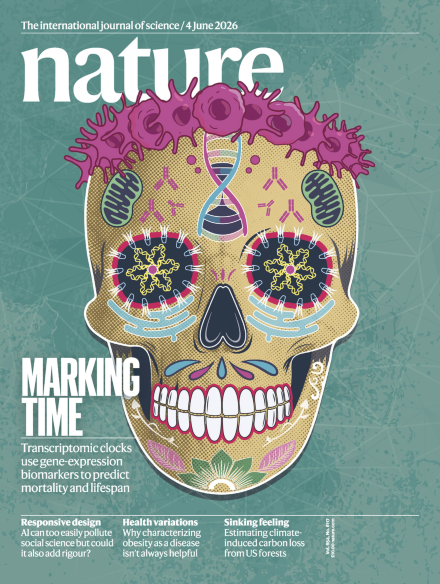
Marking time
Longevity researchers have long sought biomarkers that could be used to predict the health and lifespan of individuals. Epigenetic clocks, based on DNA methylation, have advanced this goal but they offer limited insight into underlying biological processes. In this issue, Alexander Tyshkovskiy, Vadim Gladyshev and colleagues develop a family of ‘transcriptomic clocks’ based on gene-expression data that estimate not only chronological age but also expected mortality and lifespan-modifying effects. Drawing on more than 11,000 transcriptomes spanning over 25 tissues across four mammals — mouse, rat, macaque and human — the authors identify gene-expression changes associated with ageing that are broadly conserved across species and cell types. A key aspect is that transcriptomic readouts group into functional gene modules, enabling ageing to be quantified at the level of specific biological pathways. This allows further analysis of how different cellular processes are associated with ageing and its modulation.
Cover image: Nik Spencer/Nature.
This Week
-
Editorial
-
Advertisement
-
-
World View
-
Research Highlights
News in Focus
-
News
-
Features
Books & Arts
-
Book Review
Opinion
-
Obituary
-
Comment
-
Correspondence
Work
-
Feature
-
Technology Feature
Research
-
News & Views
-
Articles
-
Matters Arising

