
This page is brought to you by Brian Golding (Golding@McMaster.CA) and is copied locally here to speed your access. To go to the original page (should you find something interesting or should you wish to follow links) click on

Current Issue of Nature


Volume 654 Issue 8118, 11 June 2026
Skip to main content

Thank you for visiting nature.com. You are using a browser version with limited support for CSS. To obtain the best experience, we recommend you use a more up to date browser (or turn off compatibility mode in Internet Explorer). In the meantime, to ensure continued support, we are displaying the site without styles and JavaScript.

Volume 654 Issue 8118, 11 June 2026

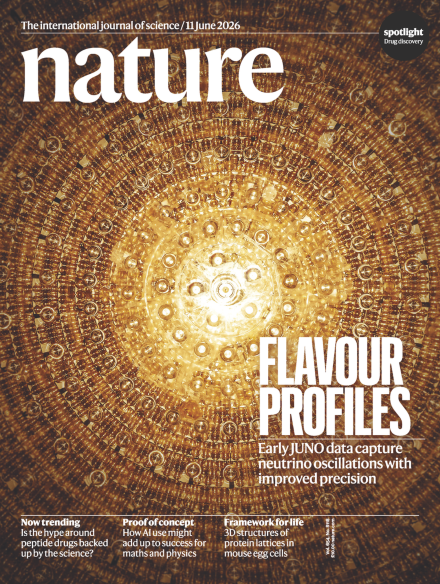
Flavour profiles

The cover image shows the array of photosensors inside the Jiangmen Underground Neutrino Observatory (JUNO) in Guangdong, China. A huge spherical tank buried 700 metres underground and filled with 20,000 tonnes of liquid, JUNO is designed to probe the physics of neutrinos in greater detail than ever before. In this week’s issue, the JUNO Collaboration reveals the results of its first 59 days of data collection. The researchers have so far been able to make precise measurements of properties that relate to neutrinos oscillating between different types. Although these measurements align with those collected by previous neutrino experiments, they already display greater accuracy, reducing the associated uncertainties by a factor of 1.6 compared with the combined experimental results from previous decades, despite the relatively small amount of data acquired. The team notes that the performance of the experiment so far suggests that JUNO is on track to achieve its main goal of determining the mass order of the known types of neutrino.

Cover image: JUNO Collaboration
This Week

Top of page ⤴

News in Focus

Top of page ⤴

Books & Arts

Top of page ⤴

Opinion

Top of page ⤴

Work

Top of page ⤴

Research

  • News & Views

  • Analysis

    • A systematic review and analysis shows how user-centred design can be integrated into, and strengthen, co-production approaches for building user-driven climate adaptation products.

      • Nabig A. Chaudhry
      • William D. Collins
      • Andrew D. Jones
      Analysis
  • Articles

    • Experimental demonstration of quantum error-correcting codes combined with error detection and post-selection applied to a trapped-ion quantum processor shows improvements in logical error rates ranging from 11× to 800× compared with several physical circuit baselines.

      • A. Paetznick
      • B. W. Reichardt
      • K. M. Svore
      Article
    • Bright squeezed vacuum light boosts nonlinear atomic tunnelling ionization more than 20-fold compared with coherent light, enabling quantum control of strong-field processes without increasing classical intensity.

      • Zhejun Jiang
      • Shengzhe Pan
      • Jian Wu
      Article Open Access
    •  A broadband, sub-wavelength time-domain microscope is described, enabling the observation that terahertz light trapped within a cavity can mediate attractive interactions in a tunable van der Waals material.

      • F. Helmrich
      • H. S. Adlong
      • T. F. Nova
      Article
    • An analysis of post-sorting plastic packaging shows that target polymer purity is similar across source-separation and post-sorting pathways, but post-sorted plastics contain more contaminants that need to be removed before recyclate production.

      • Alexandra Schmuck
      • Tiago G. A. Belé
      • Steven De Meester
      Article Open Access
    • Temporary carbon dioxide removal can offset short-lived non-CO2 climate forcers, providing a viable physical approach for crediting temporary carbon dioxide removal activities in industries in which non-CO2 emissions dominate and direct emission reductions are difficult.

      • Yue He
      • Keywan Riahi
      • Thomas Gasser
      Article Open Access
    • Analysis of 15,836 ancient West Eurasian genomes reveals hundreds of instances of directional selection, showing that sustained changes in allele frequency were widespread, rather than being rare over this period as previously assumed.

      • Ali Akbari
      • Annabel Perry
      • David Reich
      Article
    • Mapping DNA variants that modulate mortality using a starting population of 6,438 young mice defined 29 distinct loci that influence lifespan and mortality with divergent age- and sex-specific effects, as well as 30 loci that specifically couple body mass with longevity.

      • Danny Arends
      • David G. Ashbrook
      • Robert W. Williams
      Article Open Access
    • Mice with higher levels of parenting show more prosocial allogrooming towards stressed adults, and both behaviours share neural substrates in the medial preoptic area, suggesting that parenting circuitry may form an evolutionary foundation for adult-directed prosocial helping behaviour.

      • Fangmiao Sun
      • Kayla Y. Lim
      • Weizhe Hong
      Article
    • Brain-wide transcriptomic profiling in mice reveals that reproductive experience remodels the maternal brain by altering dopamine dynamics in the dorsal hippocampal formation, causing dopamine-dependent histone post-translational modifications, and thereby changes in gene expression and behaviour.

      • Jennifer C. O’Chan
      • Giuseppina Di Salvo
      • Ian Maze
      Article Open Access
    • mRNA–lipid-nanoparticle vaccines do not require type 1 conventional dendritic (cDC1) cells or the WDFY4-dependent cross-presentation pathway for CD8+ T cell priming but, instead, engage both cDC1 and cDC2 cells redundantly.

      • Suin Jo
      • Lijin Li
      • Kenneth M. Murphy
      Article
    • Macrophages can sample antigens from living cells through a trogocytosis-like mechanism that routes ingested material away from degradation, a finding that delineates a previously unknown pathway for antigen presentation to CD8 T cells.

      • Amy C. Fan
      • Rukman R. Thota
      • Matthew F. Krummel
      Article Open Access
    • CRISPR screening shows that claudin-4 is a receptor for the pro-carcinogenic B. fragilis toxin on colonic epithelial cells, and that this interaction promotes cleavage of E-cadherin, leading to epithelial barrier disruption and inflammation.

      • Maxwell T. White
      • Kang Wang
      • Cynthia L. Sears
      Article Open Access
    • An analytical pipeline called Iteratively Defined Lengths of Inaccessibility (IDLI) maps the genome-wide occupancy of a range of nucleosome types and shows that most nucleosomes exhibit programmed ‘distortion’, in which the DNA exists mainly in a partially accessible state.

      • Marty G. Yang
      • Hannah J. Richter
      • Vijay Ramani
      Article Open Access
    • Using high-resolution cryo-electron microscopy of the mouse oocyte, the cytoplasmic lattice—which is required for oocyte maturation and where oocytes store proteins for early development—is resolved.

      • Pengliang Chi
      • Xiang Wang
      • Dong Deng
      Article
    • Structural studies using cryo-electron microscopy reveal the protein constituents and architecture of the mouse oocyte cytoplasmic lattice, and provide a molecular basis for understanding its functions in embryogenesis.

      • Shuxian Liu
      • Yusong Liu
      • En-Zhi Shen
      Article
    • Structural studies of native mouse oocyte cytoplasmic lattices using cryo-electron microscopy reveal that they consist of PADI6 and subcortical maternal complex proteins plus cytoskeletal proteins, epigenetic regulators and ubiquitination factors.

      • Zeynep Ilgın Kılıç
      • Joyce van Loenhout
      • Miguel Ricardo Leung
      Article Open Access
    • Insights into the structural basis of fungal β-1,3-d-glucan synthase inhibition by caspofungin lay the groundwork for the development of next-generation echinocandins with increased potency, broader antifungal spectrum, and reduced propensity for resistance.

      • Zhenning Ren
      • Abhishek Chhetri
      • Seok-Yong Lee
      Article Open Access
Top of page ⤴

Amendments & Corrections

Top of page ⤴

Collections

  • The path forward in drug discovery isn’t always easy – and sometimes it requires creative vision or new technology to help drive progress.

    Spotlight
  • Science has come a long way since Alexander Fleming discovered penicillin on a contaminated Petri dish.

    Technology Feature
Top of page ⤴
Nature Briefing

Sign up for the Nature Briefing newsletter — what matters in science, free to your inbox daily.

Get the most important science stories of the day, free in your inbox. Sign up for Nature Briefing

Search

Quick links