
This page is brought to you by Brian Golding (Golding@McMaster.CA) and is copied locally here to speed your access. To go to the original page (should you find something interesting or should you wish to follow links) click on

Current Issue of Nature


Volume 651 Issue 8104, 5 March 2026
Skip to main content

Thank you for visiting nature.com. You are using a browser version with limited support for CSS. To obtain the best experience, we recommend you use a more up to date browser (or turn off compatibility mode in Internet Explorer). In the meantime, to ensure continued support, we are displaying the site without styles and JavaScript.

Volume 651 Issue 8104, 5 March 2026

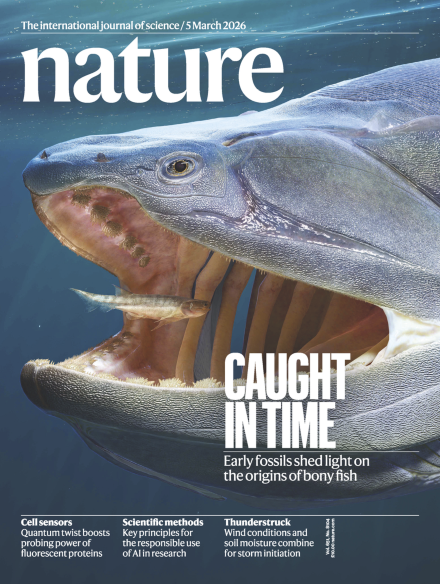
Caught in time

Bony fish account for some 98% of all vertebrate species, but the early stages of their evolution are not well understood. The core issue is the fragmented fossil record for specimens that date back earlier than the start of the Devonian Period some 419 million years ago. Across two papers in this week’s issue, Min Zhu and colleagues help to plug that gap. In the first paper, the researchers reveal the near-complete skeleton of a small bony fish dating to the early Silurian (around 436 million years ago), making it the oldest known bony fish. Named Eosteus chongqingensis, this 3-centimetre fish displays features that place it close to the earliest stages of bony fish evolution. In the second paper, the researchers reveal fossil material from the fish Megamastax amblyodus, the largest pre-Devonian vertebrate currently known. Dated to around 423 million years ago, these latest remains add an entire skull with teeth and jaws to the picture, offering fresh insight into the origin of bony fish characteristics. Both Eosteus (middle) and Megamastax are pictured in the artist’s digital model on the cover.

Cover image: NICE PaleoVislab, IVPP
This Week

Top of page ⤴

News in Focus

Top of page ⤴

Books & Arts

Top of page ⤴

Opinion

Top of page ⤴

Work

Top of page ⤴

Research

  • News & Views

  • Articles

    • Fractionally charged excitations at zero magnetic field in twisted MoTe2 bilayers, a recently discovered fractional quantum anomalous Hall system, are observed via anyon-trions, excitonic complexes formed by binding a trion to a fractional charge.

      • Weijie Li
      • Christiano Wang Beach
      • Xiaodong Xu
      Article
    • Wide-field quantum sensing shows μm-scale inhomogeneous superconductivity in high-pressure La3Ni2O7, linking local diamagnetic response to stress and stoichiometry and clarifying mechanisms that suppress or enhance superconductivity.

      • S. V. Mandyam
      • E. Wang
      • N. Y. Yao
      Article Open Access
    • A lab-scale proof-of-principle demonstration of a quantum network comprising one server chip and 20 client photonic chips implementing twin-field quantum key distribution shows excellent scalability and reliability and yields a pathway towards future large-scale networks.

      • Yun Zheng
      • Hanyu Wang
      • Jianwei Wang
      Article Open Access
    • A strategy using simple one-step spin-coating to form 3D/2D vertically oriented perovskite heterojunctions is described, allowing the fabrication of perovskite light-emitting diodes with record-high green emission efficiencies of 42.9% (certified 42.3%).

      • Jingyu Peng
      • Xulan Xue
      • Wenyu Ji
      Article
    • A cold-injection method based on pseudo-emulsion enables scalable synthesis of stable, pure-green perovskite nanocrystals with near-unity photoluminescence quantum yield, achieved through defect-suppressing slow polybromide plumbate assembly at cold temperatures.

      • Sungjin Kim
      • Sun-Ah Kim
      • Tae-Woo Lee
      Article
    • A tool based on the Llama-3.1-8B-Instruct architecture called MOSAIC (Multiple Optimized Specialists for AI-assisted Chemical Prediction) is described, allowing chemists to use the collective intelligence of millions of reaction protocols to realize new compounds.

      • Haote Li
      • Sumon Sarkar
      • Victor S. Batista
      Article
    • A tiny, articulated, near-complete osteichthyan from the early Silurian Chongqing Lagerstätte, represents the oldest osteichthyan occurrence including microfossils, and the earliest articulated remains of any bony fish in the fossil record.

      • You-An Zhu
      • Yang Chen
      • Min Zhu
      Article
    • A spatial and single-cell transcriptomics study across multiple mammalian species identifies epidermal BMP signalling as a functional requirement for rete ridge formation, providing insight into mechanisms underlying hair density loss and wound healing.

      • Sean M. Thompson
      • Violet S. Yaple
      • Ryan R. Driskell
      Article Open Access
    • Analysis of data from pre-implantation genetic testing sheds light on the genetic basis of meiotic-origin aneuploidy, the leading cause of human pregnancy loss, identifying common genetic variants associated with maternal meiotic errors.

      • Sara A. Carioscia
      • Arjun Biddanda
      • Rajiv C. McCoy
      Article Open Access
    • Noradrenergic circuits support and balance aggressive behavioural states in predatory nematodes, distinguish predatory from non-predatory nematode species and are associated with the evolution of complex behavioural traits.

      • Güniz Göze Eren
      • Leonard Böger
      • James W. Lightfoot
      Article Open Access
    • Muscularis macrophages, housekeepers of enteric nervous system integrity and intestinal homeostasis, modulate α-synuclein pathology and neurodegeneration in models of Parkinson’s disease, and understanding the accompanying mechanisms could pave the way for early-stage biomarkers.

      • Sebastiaan De Schepper
      • Viktoras Konstantellos
      • Tim Bartels
      Article Open Access
    • An outbreak of MPXV in sooty mangabeys in Côte d’Ivoire was linked to MPXV-infected fire-footed rope squirrels, providing direct evidence of interspecies transmission and indicating risk for zoonotic transmission of MPXV from both hosts.

      • Carme Riutord-Fe
      • Jasmin Schlotterbeck
      • Fabian H. Leendertz
      Article Open Access
    • A metagenomic survey of babies attending the first year of nursery detected extensive baby-to-baby microbial strain transmission, pointing to social interactions in infancy as crucial drivers of infant microbiome development.

      • Liviana Ricci
      • Vitor Heidrich
      • Nicola Segata
      Article Open Access
    • Analysis of the somatic and transcriptomic profile of 123 acral melanoma samples from Mexican patients helps understand tumour origins and prognosis, and highlights the importance of including samples from diverse ancestries in cancer genomics studies.

      • Patricia Basurto-Lozada
      • Martha Estefania Vázquez-Cruz
      • Carla Daniela Robles-Espinoza
      Article Open Access
    • The high-plasticity cell state (HPCS) is a critical hub that enables reciprocal transitions between cancer cell states, and targeting the HPCS may suppress cancer progression and eradicate treatment resistance.

      • Jason E. Chan
      • Chun-Hao Pan
      • Tuomas Tammela
      Article Open Access
    • De novo designed proteins that target the transmembrane domain of G-protein-coupled receptors, created using iterative structural predictions, are able to act as agonist-positive, negative or biased allosteric modulators of downstream activity.

      • Shizhuo Cheng
      • Jia Guo
      • Yan Zhang
      Article
    • Cryogenic electron microscopy structures of human Ostα/β uncover a unique transport pathway featuring two substrate-binding sites connected by an amphipathic helix-gated conduit, and electrophysiological studies demonstrate voltage-sensitive, bidirectional transport, showing its efflux role in vivo.

      • Xuemei Yang
      • Nana Cui
      • H. Eric Xu
      Article
Top of page ⤴

Amendments & Corrections

Top of page ⤴
Nature Briefing

Sign up for the Nature Briefing newsletter — what matters in science, free to your inbox daily.

Get the most important science stories of the day, free in your inbox. Sign up for Nature Briefing

Search

Quick links