
Volume 651 Issue 8105, 12 March 2026
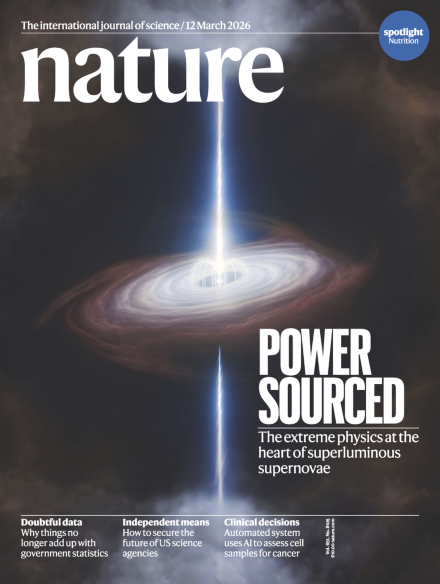
Power sourced
Superluminous supernovae are at least ten times brighter than their regular counterparts, but astronomers have remained in the dark about what exactly powers these phenomena. In this week’s issue, Joseph Farah and colleagues confirm that magnetars — highly magnetized neutron stars formed by a supernova — are a driving force of these explosions. The researchers analysed light emitted by a superluminous supernova more than a billion light years from Earth. Using a new model of the supernova, they determined that a rapidly rotating magnetar is at the centre of the explosion, and that the massive amounts of energy deposited into the supernova ejecta is the cause of the superluminous glow. A disk of accreting matter spins around the magnetar (as pictured on the cover) and this disk ‘wobbles’ owing to an effect predicted by Einstein’s general theory of relativity. This results in the amount of energy being deposited fluctuating, accounting for the unique rise and fall in the supernova’s brightness observed from Earth.
Cover image: Joseph R. Farah/Curtis McCully.
This Week
-
Editorial
-
Advertisement
-
-
World View
-
Research Highlights
News in Focus
-
News
Features
Books & Arts
-
Book Review
-
Essay
Opinion
-
Comment
-
Correspondence
Work
-
Feature
-
Technology Feature
Research
-
News & Views
-
Articles

