
This page is brought to you by Brian Golding (Golding@McMaster.CA) and is copied locally here to speed your access. To go to the original page (should you find something interesting or should you wish to follow links) click on

Current Issue of Nature


Volume 651 Issue 8106, 19 March 2026
Skip to main content

Thank you for visiting nature.com. You are using a browser version with limited support for CSS. To obtain the best experience, we recommend you use a more up to date browser (or turn off compatibility mode in Internet Explorer). In the meantime, to ensure continued support, we are displaying the site without styles and JavaScript.

Volume 651 Issue 8106, 19 March 2026

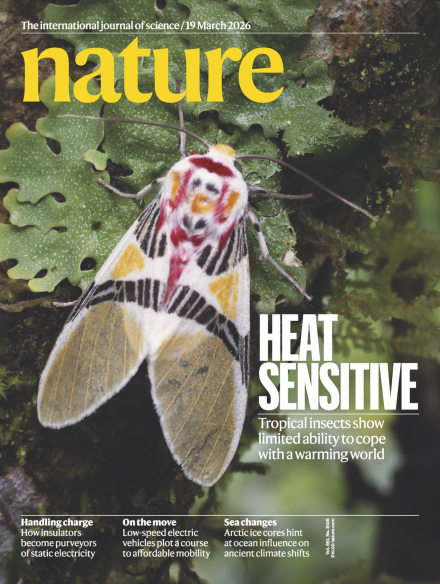
Heat sensitive

The cover shows the moth Idalus iragorri, one of many insect species found at low to medium elevations in the eastern Andes. More than 70% of all insect species are found in the tropics, but the potential effects of global warming on these key components of the ecosystem are not well understood. In this week’s issue, Kim Holzmann and colleagues aim to resolve this with an analysis of around 2,300 insect species from Africa and South America. They found that insects at high elevations were better able to adapt to higher temperatures, but at lower levels they were not. Overall, the team found that insects in the tropics have a limited capacity to cope with global warming — half the lowland insects that were studied are at risk of dying as a result of projected higher temperatures.

Cover image: Gunnar Brehm.
This Week

Top of page ⤴

News in Focus

Top of page ⤴

Books & Arts

Top of page ⤴

Opinion

Top of page ⤴

Work

Top of page ⤴

Research

  • News & Views

  • Articles

    • Self-bound droplets and droplet arrays are observed in an ultracold gas of strongly dipolar sodium–caesium molecules, establishing ultracold molecules as a system for the exploration of strongly dipolar quantum matter.

      • Siwei Zhang
      • Weijun Yuan
      • Sebastian Will
      Article
    • Olympiad-level formal mathematical reasoning is achieved with reinforcement learning, with performance reaching a score equivalent to that of a silver medallist at the 2024 International Mathematical Olympiad competition.

      • Thomas Hubert
      • Rishi Mehta
      • David Silver
      Article Open Access
    • The synthesis of millimetre-sized phase-pure hexagonal diamond, a polymorph of cubic diamond, by compressing highly oriented pyrolytic graphite under high pressures and temperatures is reported, providing new insight into the graphite-to-diamond transformation pathway.

      • Shoulong Lai
      • Xigui Yang
      • Chongxin Shan
      Article
    • By measuring charge exchange in a sphere/plate pair composed of identical amorphous silicon dioxide and controlling charging polarity using baking or plasma treatment, adventitious carbon is shown to break symmetry in oxide contact electrification.

      • Galien Grosjean
      • Markus Ostermann
      • Scott R. Waitukaitis
      Article Open Access
    • A method is described for the manufacture of pivoting colloidal assemblies comprising rotating diamond and rotating triangle geometries that show tunable folding and unfolding by thermal fluctuations and actuation by magnetic attractions.

      • Julio Melio
      • Martin van Hecke
      • Daniela J. Kraft
      Article
    • A machine-learning workflow has been developed to predict the enantioselectivity of asymmetric catalytic reactions using only sparse data for training.

      • Simone Gallarati
      • Erin M. Bucci
      • Matthew S. Sigman
      Article Open Access
    • Estimates of mean ocean temperature based on noble gas (Xe/Kr) measurements in shallow ice cores from the Allan Hills blue ice area, Antarctica, indicate enhanced cooling around the Plio-Pleistocene Transition and enhanced ice sheet growth around the time of the Mid-Pleistocene Transition.

      • Sarah Shackleton
      • Valens Hishamunda
      • John Higgins
      Article
    • A survey of tropical insect populations and thermal tolerance limits indicates that species from lowland areas have low capacity to survive increased temperatures, and that thermal tolerance is limited by fundamental properties of protein architecture.

      • Kim L. Holzmann
      • Thomas Schmitzer
      • Marcell K. Peters
      Article Open Access
    • The Huayuan biota exhibits extraordinary biodiversity, illuminating the impact of the Phanerozoic mass extinction around 513 million years ago and offering critical insights into the transformation of global ecosystems in the early Cambrian.

      • Han Zeng
      • Qi Liu
      • Maoyan Zhu
      Article
    • A large cross-population atlas of gene–environment interactions reveals how age, sex and lifestyle shape genetic effects, heritability, prediction accuracy and disease biology, with implications for personalized medicine and drug development.

      • Shinichi Namba
      • Kyuto Sonehara
      • Yukinori Okada
      Article Open Access
    • Population-level analyses and in vitro experiments show that a specific genetic variant of cyclin D3 inhibits the growth of the malaria-causing parasite Plasmodium falciparum in erythrocytes, and suggest that its high frequency in Sardinia was driven by past endemic malaria.

      • Maria Giuseppina Marini
      • Maura Mingoia
      • Francesco Cucca
      Article Open Access
    • Risk associated with genetically defined forms of autism spectrum disorder (ASD) can propagate by means of transcriptional regulation to affect convergently dysregulated pathways, providing insight into the convergent impact of ASD genetic risk on human neurodevelopment.

      • Aaron Gordon
      • Se-Jin Yoon
      • Daniel H. Geschwind
      Article Open Access
    • Systematic screening of transcription factors reveals conserved mechanisms governing cortical radial glia lineage progression across primates and provides a framework for functional dissection of gene regulatory networks in human cortical neurogenesis.

      • Jingwen W. Ding
      • Chang N. Kim
      • Alex A. Pollen
      Article Open Access
    • Transcription factor osr2 is identified as a specific marker and regulator of mural lymphatic endothelial cell (muLEC) differentiation and maintenance, and muLECs and border-associated macrophages share functional analogies but are not homologous, providing an example of convergent evolution.

      • Andrea U. Gaudi
      • Michelle Meier
      • Benjamin M. Hogan
      Article Open Access
    • DeepRare—a multi-agent system for rare disease differential diagnosis decision support powered by large language models, integrating specialized tools and up-to-date knowledge sources—has the potential to reduce healthcare disparities in rare disease diagnosis.

      • Weike Zhao
      • Chaoyi Wu
      • Weidi Xie
      Article Open Access
    • In vivo base editing of a causative mutation that leads to the neurodevelopmental disorder Snijders Blok–Campeau syndrome restores protein dosage and ameliorates molecular and behavioural deficits in a humanized mouse model of the condition.

      • Kan Yang
      • Wei-Ke Li
      • Zilong Qiu
      Article Open Access
    • ATF6α activation in human and preclinical models of hepatocellular carcinoma is significantly associated with an aggressive tumour phenotype characterized by reduced survival, glycolytic reprogramming and local immunosuppression.

      • Xin Li
      • Cynthia Lebeaupin
      • Mathias Heikenwälder
      Article Open Access
    • Polyamines prevent the action of kinases on acidic phosphorylatable motifs in spliceosomal proteins, thus providing a mechanism for metabolite-mediated regulation of alternative splicing in cells.

      • Amaia Zabala-Letona
      • Mikel Pujana-Vaquerizo
      • Arkaitz Carracedo
      Article Open Access
    • Psychedelics and their non-hallucinogenic analogues were compared, revealing that serotonin 2A receptor (5-HT2AR)-mediated Gi signalling is essential for hallucinogenic effect, with the functional mechanisms underlying this providing insights for designing therapeutic drugs without hallucinogenic effects.

      • Zheng Xu
      • Hongshuang Wang
      • Zhenhua Shao
      Article
Top of page ⤴

Amendments & Corrections

Top of page ⤴
Nature Briefing

Sign up for the Nature Briefing newsletter — what matters in science, free to your inbox daily.

Get the most important science stories of the day, free in your inbox. Sign up for Nature Briefing

Search

Quick links