
This page is brought to you by Brian Golding (Golding@McMaster.CA) and is copied locally here to speed your access. To go to the original page (should you find something interesting or should you wish to follow links) click on

Current Issue of Nature


Volume 651 Issue 8107, 26 March 2026
Skip to main content

Thank you for visiting nature.com. You are using a browser version with limited support for CSS. To obtain the best experience, we recommend you use a more up to date browser (or turn off compatibility mode in Internet Explorer). In the meantime, to ensure continued support, we are displaying the site without styles and JavaScript.

Volume 651 Issue 8107, 26 March 2026

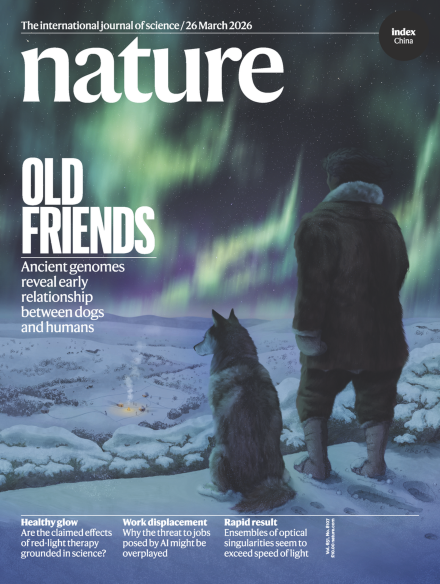
Old friends

The cover shows an artist’s impression of a human and their canine companion near a settlement in Ice Age Switzerland. Dogs have been companions for humans for millennia. They were the first animal to be domesticated, and remains with possible dog morphology have been dated to at least 14,000 years ago. But the exact origins and nature of early dogs remain a mystery. Two papers in this week’s issue go some way to resolving this problem. In one, Anders Bergström, Pontus Skoglund and colleagues analyse the genomes of some 200 ancient dog and wolf remains, while in the other, William Marsh, Lachie Scarsbrook, Laurent Frantz and colleagues report the genome sequences of two dogs dating back to 14,000–16,000 years ago — the earliest dogs to be sequenced. Together, the papers show that dogs were widely distributed across western Eurasia long before the introduction of agriculture. They also find evidence that the genetic diversification of dogs started much earlier than had previously been thought.

Cover image: Oliver Uberti
This Week

Top of page ⤴

News in Focus

Top of page ⤴

Books & Arts

Top of page ⤴

Opinion

Top of page ⤴

Work

Top of page ⤴

Research

  • News & Views

  • Reviews

    • Intelligent and miniaturized drug delivery devices leveraging advances in biotechnology, artificial intelligence, electronics and materials science enable treatments with increased precision and responsiveness, with applications in cancer, diabetes, cardiovascular disease and other diseases.

      • Xinwei Wei
      • John B. Buse
      • Zhen Gu
      Review Article
  • Articles

    • An artificial intelligence system can produce research papers with minimal human involvement, even passing the first round of peer review for the workshop of a main machine learning conference.

      • Chris Lu
      • Cong Lu
      • Jeff Clune
      Article Open Access
    • An integrated photonic deep neural network was trained end-to-end with on-chip gradient-descent backpropagation, and all linear and nonlinear computations were performed on a single photonic chip, resulting in a reliable performance despite on-chip errors and variations.

      • Farshid Ashtiani
      • Mohamad Hossein Idjadi
      • Kwangwoong Kim
      Article
    • A new framework links specific emissions to monetized, location-specific climate damages, showing that future harms from past CO2 emissions far exceed historical damages and that delayed carbon removal cannot fully offset these losses.

      • Marshall Burke
      • Mustafa Zahid
      • Solomon Hsiang
      Article Open Access
    • Using nitrogen isotopes from ancient and modern fish otoliths and corals, the study shows Caribbean reef food webs are now 60–70% shorter and functionally less diverse, indicating human-driven trophic simplification and increased risk of collapse.

      • Jessica A. Lueders-Dumont
      • Aaron O’Dea
      • Xingchen Tony Wang
      Article Open Access
    • Genome-wide analysis shows European dogs existed by 14,200 years ago, were already genetically distinct, received less Neolithic Southwest Asian admixture than humans did and contributed substantially to later European dogs.

      • Anders Bergström
      • Anja Furtwängler
      • Pontus Skoglund
      Article Open Access
    • Analysis of nuclear and mitochondrial genomes from archaeological canid remains found across Europe and Anatolia shows that a genetically homogeneous dog population was already widely distributed across the region by 15,000 years ago.

      • William A. Marsh
      • Lachie Scarsbrook
      • Laurent A. F. Frantz
      Article Open Access
    • Evolutionarily related ‘proto-point’ centromeres providing resolution to the evolutionary origins of point centromeres are identified in yeast, and comparison shows they evolved in an ancestor with retrotransposon-rich centromeres and that long-terminal-repeat retrotransposons are the genetic substrate.

      • Max A. B. Haase
      • Luciana Lazar-Stefanita
      • Jef D. Boeke
      Article Open Access
    • Thousands of centromeres were identified and tracked across two major fungal clades, showing that new centromeres spread progressively and that the kinetochore acts as a filter to determine which new centromere variants are tolerated.

      • Jana Helsen
      • Kausthubh Ramachandran
      • Gautam Dey
      Article Open Access
    • Systemic flavivirus dissemination in mosquitoes following initial infection requires protein–protein interactions within extracellular vesicles, which enable infectious particles to be transported through haemolymph and confer species specificity.

      • Jichen Niu
      • Jun Ma
      • Gong Cheng
      Article
    • Bacteria use diverse defence systems against phages, including a 164-residue prophage-encoded protein, Rip1, which senses conserved phage assembly rings to form membrane pores that block virion maturation and trigger premature host cell death.

      • Pramalkumar H. Patel
      • Matthew R. McCarthy
      • Karen L. Maxwell
      Article
    • The distinct architecture of the Escherichia coli membrane transporter LetA mediates lipid trafficking across the bacterial envelope in partnership with the tunnel-like complex LetB.

      • Cristina C. Santarossa
      • Yupeng Li
      • Gira Bhabha
      Article Open Access
    • PARM is a deep-learning model trained on data from massively parallel reporter assays to help predict promoter activity in different human cell types, design synthetic promoters and identify key features of regulatory promoter grammar.

      • Lucía Barbadilla-Martínez
      • Noud Klaassen
      • Bas van Steensel
      Article Open Access
Top of page ⤴

Amendments & Corrections

Top of page ⤴

Nature Index

  • China’s lead in the Nature Index is growing, but for how long can it continue on this trajectory?

    Nature Index
Top of page ⤴
Nature Briefing

Sign up for the Nature Briefing newsletter — what matters in science, free to your inbox daily.

Get the most important science stories of the day, free in your inbox. Sign up for Nature Briefing

Search

Quick links