This page is brought to you by Brian Golding (Golding@McMaster.CA)
and is copied locally here to speed your access. To go to the
original page (should you find something interesting or should you
wish to follow links) click on
Thank you for visiting nature.com. You are using a browser version with limited support for CSS. To obtain
the best experience, we recommend you use a more up to date browser (or turn off compatibility mode in
Internet Explorer). In the meantime, to ensure continued support, we are displaying the site without styles
and JavaScript.
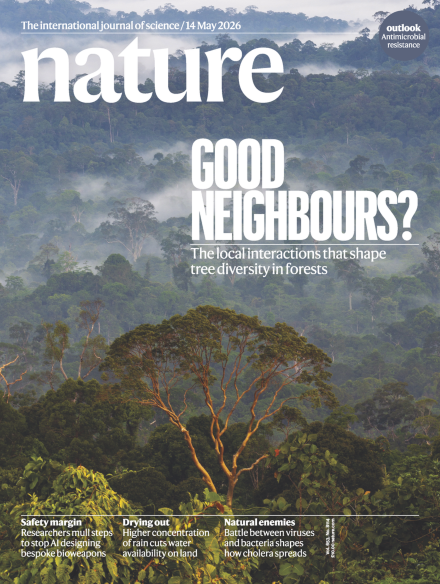
The cover captures a tropical forest in Danum Valley, Malaysia, veiled in mist. Species diversity declines as you move from the equator towards the poles. This decline is particularly marked in trees, although the exact mechanism behind it is the source of some debate. At the heart of the discussion is the fact that neighbouring trees of the same species compete with each other more strongly than do trees of different species. But the question remains of whether this effect is largely the result of pairwise interactions between two neighbouring trees, or if it also involves higher-order interactions in which other trees influence the pairwise interactions. In this week’s issue, Chengjin Chu and colleagues reveal that higher-order interactions do indeed exert an effect. The researchers examined 32 large forest plots located mainly in the Northern Hemisphere and in subsequent modelling found evidence for higher-order interactions in all of them. They found that these interactions tend to benefit rare species but disadvantage common species, and that their overall effect declines at higher latitudes, underlining that they are a potential mechanism for promoting species diversity.
The United Nations wants scientists to help design indicators of progress that go beyond GDP. Researchers should seize the chance and be aware of past failures.
Bombing of Iran’s civilian infrastructure has damaged universities and destroyed thousands of books and manuscripts, amid a government-imposed Internet blackout, some of the country’s researchers have told Nature.
A new book brings together ethnography, neurobiology and primatology to argue that how much our species sleeps is an evolutionary trade-off, with lessons for how each of us can sleep better.
Trajectories of obesity prevalence over the past 45 years reveal patterns of growth, plateau and decline that differ across high-, middle- and low-income countries.
When the concept of ‘click’ chemistry — highly effective and specific reactions — was first reported, some dismissed it as a gimmick. But it has transformed many fields of research.
Genomics and experimental data suggest that an evolutionary arms race between cholera-causing bacteria and their viral predators shapes the disease in humans.
An observation of an ultra-faint galaxy, captured as it was shortly after the Big Bang, indicates the presence of material from the first generation of stars.
If general cancer treatment fails, a tumour-type-specific therapy might be tried for other cancers with genetic changes in the targeted pathway. How well does this work?
Mobile quantum bits, which can be shuttled to where they are needed in a circuit, have been used to perform a quantum process called state teleportation.
LAP1-B—an ultra-faint and tiny galaxy that formed in the reionization era and is strongly magnified by gravitational lensing—is chemically primitive and hosts very few stars in an otherwise dominant dark matter halo.
James Webb Space Telescope observations show powerful high-redshift quasar outflows, supporting quasar feedback as a key mechanism driving rapid star-formation quenching in early massive galaxies.
A new calculation for the anomalous magnetic moment of the muon using a hybrid approach combining experimental and lattice data in different energy ranges represents a validation of the standard model to 11 digits.
The acoustic Purcell effect is observed by constructing a specially engineered, microwave-frequency nanomechanical resonator around a colour centre spin qubit in diamond.
The experimental observation of a fundamentally new type of anomalous Hall effect that couples both in-plane and out-of-plane orbital magnetizations in multilayer rhombohedral graphene is reported.
A device architecture comprising silicon-based mobile qubits and the shuttling of two electron spins together demonstrates two-qubit gate fidelity of about 99% as well as quantum state teleportation between qubits separated by 320 nm.
Multilayer capacitors comprising a solid solution of two electrocaloric materials PbSc0.5Ta0.5O3 and PbMg0.5W0.5O3 are shown to maintain high B-site order and latent heat without needing an energetically expensive anneal, enabling efficient refrigeration across room temperature.
A potential premediator, 2-chloropyrimidine, could be a model material for molecular skeleton design enabling lithium–sulfur batteries to achieve a strong average capacity retention and help design functional molecules in broader organic chemical spaces.
A new approach to magnetic resonance imaging, ‘multiplexed magnetic resonance imaging’, is reported, which enables high-resolution simultaneous multiparametric mapping of multiple molecules in standard clinical settings.
Higher-order interactions are shown to contribute to the decrease in species diversity from low to high latitudes in global forests, potentially explaining why this intricate phenomenon cannot be adequately explained by pairwise interactions alone.
Using blood-based genome sequence data, non-genetic and genetic factors associated with control of Epstein–Barr virus during persistent infection are reported.
Synchronous activation of climbing fibres engages disinhibitory circuitry to promote large dendritic calcium signals in Purkinje cells that are necessary to promote cerebellar learning.
Paracrine signalling between tuft cells and enterochromaffin cells is a key mode of immune–sensory and gut–brain communication, and accounts for the pattern of gastrointestinal symptoms that occurs during parasite infections.
SnRK1β1A in rice promotes susceptibility to multiple fungal diseases, and disrupting this infection-inducible gene confers broad-spectrum resistance without compromising growth or yield under normal field conditions.
The acquisition of a parasitic anti-phage mobile genetic element, PLE11, showing potent anti-phage activity against cocirculating ICP1, and the subsequent evolution of ICP1 to escape this defense, are captured, revealing the molecular basis of the natural selection of a globally notable pathogen and its virus.
The seventh cholera pandemic, driven by El Tor Vibrio cholerae, evolved separately in Bangladesh and India, with the Ganges Basin acting as the global source, and its evolution has been shaped by phage defence system changes, influencing severity and transmission.
In mice, a low-protein diet leads to a gut-microbiota-driven remodelling of adipose tissue towards brown fat, showing that gut microorganisms have a role in detecting and responding to a lack of protein.
Global analysis of obesity trends from 1980 to 2024 in 200 countries and territories using data from 4,050 population-based studies reveals that framing obesity as a single global epidemic masks the highly varied dynamics across countries and age groups.
Neonatal sepsis caused by Escherichia coli is associated with reduced transfer of pathogen-specific maternal antibodies and, in a mouse model, can be prevented by maternal preconceptual colonization with probiotic E. coli.
A study of antigen-presenting cells called Thetis cells sheds light on their development and transcriptional regulation in mice, which has implications for the tolerance of gut microbiota and food antigens.
Exhausted CD8+ T cells increase proteasome activity due to the accumulation of depolarized mitochondria, which drives the selective degradation of mitochondrial proteins and releases of regulatory haem through haemoprotein breakdown.
Evaluation by the Drug Rediscovery Protocol of off-label use of 37 approved cancer drugs on 1,610 patients showed modest activities overall, although subgroups of responders suggest that off-label drug use could be beneficial in tandem with more stringent biomarker selection.
Glucocorticoid receptor activation is a key driver of resistance of triple-negative breast cancer to both CD8+ T cells and natural killer cells during initial metastatic seeding.
INSTALL overcomes fundamental challenges for DNA delivery and integration methods by synergizing immune-stealth nucleic acids with recombinases to enable kilobase-scale integration strategies without viral vectors.
A synthetic genetic circuit made up of recombinase-based cell-fate branching devices enables precise control over the ratios of cell types in an offspring population derived from one founder strain, and could be used to build user-defined multicellular aggregates.
cf-EpiTracing enables automated profiling of histone modifications in cell-free DNA from human plasma, allowing identification of the cells of origin and disease diagnosis.
Cryo-electron microscopy and massively parallel assays shed light on the mechanism by which DICER, a key enzyme in the RNase III family, cleaves RNA at precise locations to produce small RNAs.
Marburgvirus glycoprotein binds to the endosomal receptor NPC1 in a distinct orientation with higher affinity compared with Ebola virus glycoprotein, accompanied by fusion-relevant rearrangements, enabling more efficient viral entry.