
This page is brought to you by Brian Golding (Golding@McMaster.CA)
and is copied locally here to speed your access. To go to the
original page (should you find something interesting or should you
wish to follow links) click on
Thank you for visiting nature.com. You are using a browser version with limited support for CSS. To obtain
the best experience, we recommend you use a more up to date browser (or turn off compatibility mode in
Internet Explorer). In the meantime, to ensure continued support, we are displaying the site without styles
and JavaScript.
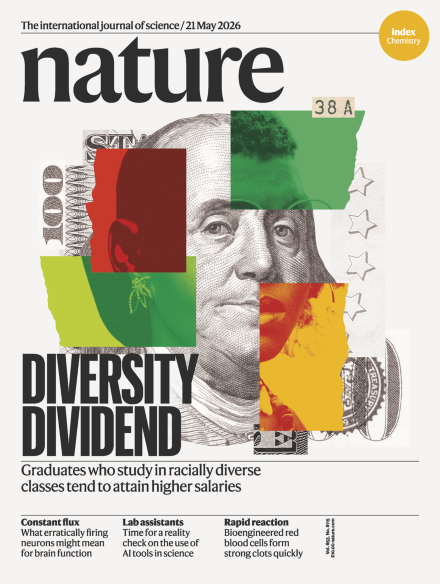
Is there any relationship between salaries attained by graduates and the racial diversity of their classmates? This question has generated significant debate but there is a paucity of empirical evidence to help resolve it. In this week’s issue, Debanjan Mitra, Peter Golder and Mariya Topchy add to that evidence by showing that students who study within racially diverse graduating classes tend to receive higher salaries upon graduation. The researchers used datasets covering two high-earning professional degrees in the USA: Master of Business Administration (MBA) and Juris Doctor (JD). They looked at 2,964 graduating classes across 141 business schools covering 29 years for MBAs, and at 3,386 graduating classes across 200 law schools and 21 years for JDs. For both degrees, they found that higher racial diversity among classmates was associated with higher median starting salaries. The researchers suggest this implies that policies to increase racial diversity among students in higher education could enhance human capital and benefit society.
Cover image: Jasiek Krzysztofiak/Nature with adapted photos from Pexel and Unsplash.
Mental illness needs visibility more urgently than almost any other area of medicine and health care. A new award from Wellcome and Nature aims to raise its prominence.
With the arrival of ‘AI scientists’, it’s as well to remember that human wisdom, empathy and sheer messiness are as much part of progress as are process and efficiency.
Science publishing giant Elsevier has joined a class-action lawsuit against Meta that alleges the reproduction of copyrighted works in developing the Llama AI model.
Artificial intelligence is rapidly accelerating scientific output, but risks narrowing inquiry, weakening judgement and undermining how scientists are trained.
The interplay between variants of human immune-system genes and strains of Epstein–Barr virus underpins differences in susceptibility to an uncommon throat cancer.
Genetic variants in GLP1R and GIPR, which encode targets of GLP-1-based medications, offer insights into why responses to these drugs vary and who might face adverse effects.
Rational design of a regulatory protein decouples the ability to tolerate cold from the means to acquire phosphorus, effectively enhancing crop yield under cold stress.
DNA rearrangements in immune-system B cells generate diverse antibody-encoding genes and help to avoid producing antibodies that target the body’s own tissues.
A programmable photonic quantum processor, Jiuzhang 4.0, incorporates 1,024 high-efficiency squeezed states into a hybrid spatial–temporal encoded 8,176-mode circuit.
Researchers enable hidden-object imaging on consumer LiDAR by fusing multiple frames with a motion-based model, achieving three-dimensional reconstruction, tracking and localization using low-cost, off-the-shelf smartphone sensors.
By using singularity physics to enable cubic-root scaling of frequency and phase modulations induced by the Coriolis effect to enhance the performance of chip-scale Coriolis vibratory gyroscopes, substantial improvements in signal-to-noise ratio and precision are demonstrated.
An autonomous closed-loop framework combining machine-learning-driven materials discovery with an automated manufacturing platform is introduced for the highly reproducible production of perovskite solar cells that demonstrate high power conversion and certified maximum power point tracking efficiencies.
Electron-beam control enables deterministic placement of tens of thousands of atomic defects in three-dimensional crystals, creating stable, programmable artificial matter for scalable quantum and nanoscale technologies.
Engineered blood clots using rapidly crosslinked red blood cells form within seconds, greatly improving toughness and adhesion while effectively stopping bleeding and enhancing tissue repair.
A modular carbonyl replacement strategy converts common cyclic ketones into diverse saturated heterocycles, enabling efficient synthesis and late-stage diversification of bioactive molecules.
A reconstruction method based on Gaussian-apodized single-sideband electron ptychography removes artefacts to enable the high-fidelity identification of guest species in porous materials.
A twenty-first century fire is shown to be the first to have affected a high-elevation region in the central African mountains in the past 12,000 years, and previous burning at mid-elevations highlights the potential role of humans in transforming Afromontane ecosystems.
Analysis of laboratory experiments using a rate-and-state-based Griffith-like rupture framework shows that foreshocks can regulate mainshock nucleation timing, with larger foreshocks generating higher transient sliding velocities and triggering a more rapid transition to dynamic rupture.
A longitudinal study shows that racial diversity in higher education is associated with higher student salaries at graduation, indicating that policies to increase or leverage racial diversity enhance human capital and benefit society.
Analyses of large-scale, multitaxa and long-term thermophilization patterns in forests, grasslands and alpine summits across Europe provide insight into shifts in community composition among different ecosystems in a warming world.
Identification of genetic variants associated with the efficacy and side effects of GLP1 medications could underpin development of precision medicine approaches in the treatment of obesity.
GLP-1–GIP–lanifibranor, a single-molecule agonist of GLP-1R, GIPR, PPARα, PPARγ and PPARδ, shows promising therapeutic efficacy against obesity-linked metabolic dysfunction in vitro and in mouse models via synergistic incretin and PPAR activity.
A genome-to-genome association study identifies host and viral risk factors that interact to drive nasopharyngeal carcinoma endemicity in southern China.
Decreased brain volumes and increased NfL levels can be observed earlier than disease diagnosis in short-tandem-repeat-associated neurological diseases.
DNA damage burden and inadequate repair in CUX2+ cortical layer 2/3 excitatory neurons contributes to selective vulnerability in neuroinflammatory injury.
The transcription factor ATF4 is shown to regulate double-stranded DNA repair within vulnerable CUX2+ upper-layer 2/3 cortical neurons, enabling their survival during development.
The E3 ubiquitin ligase NLA postively regulates cold tolerance and negatively regulates phosphate uptake in maize, and a genetically engineered variant of this enzyme leads to improved cold tolerance and enhanced phosphate uptake, improving yield in field trials.
Stacking XA48-mediated effector-triggered immunity with XA21-mediated pattern-triggered immunity in Oryza sativajaponica reconstitutes the broad-spectrum resistance from wild rice.
A widespread bacterial defence system called SNIPE is shown to localize to the cell membrane, where it identifies and cleaves the DNA of infecting phage as it is injected into the bacterial cell.
Studies explaining the secondary Igk recombination mechanism are described and Cer/Sis deletion and/or displacement is implicated as a developmental switch converting the rearrangement mechanisms from two-loop-based diffusional primary Igk into one-loop-based linear scanning secondary mechanisms.
Insights into the mechanism by which phosphatidylserine functions as a non-classical inhibitory molecule during T cell exhaustion, and how phosphatidylserine-targeting antibodies enhance T cell responses are explored.
A fusion protein designed to comprise IL-2 and a helminth-derived TGFβ mimic activates IL-2 and TGFβ signalling pathways in IL-2 receptor-expressing T cells and induces stable antigen-specific regulatory T cells in peripheral lymphoid organs.
High-depth sequencing of non-cancerous tissue from patients with metastatic cancer reveals single-base mutational signatures of alcohol, smoking and cancer treatments, and reveals how exogenous factors, including cancer therapies, affect somatic cell evolution.
DNA-sequencing data from primary tumours and paired metastases from participants in the TRACERx lung study and PEACE autopsy programme are used to analyse the metastatic diversity of advanced non-small cell lung cancer and the seeding patterns that underpin it.
A clinical phase 1 trial of a single infusion of CS-101, CD34+ cells modified using a transformer base editor to reactivate fetal haemoglobin production, led to early and enduring transfusion independence in patients with β-thalassaemia.
Catabolism of extracellular glutathione by γ-glutamyltransferases supports tumour growth and survival, and pharmacological targeting of these enzymes slows tumour growth.
Combining single-cell parallel profiling of genome conformation, histone modifications, chromatin accessibility and gene expression reveals dynamics and intranuclear spatial clustering of epigenome profiles, enabling sophisticated analysis of the regulatory landscape across cell types and tissues.
Multiple complexes that contain various RAD51 paralogues involved in homologous recombination are revealed, highlighting the structural, functional and mechanistic importance of these complexes.
Data from cryogenic electron microscopy combined with hydrogen–deuterium exchange mass spectrometry inform a mechanism for cold-evoked activation of the TRPM8 channel, providing a structural and energetic framework to explain cold sensitivity.