This page is brought to you by Brian Golding (Golding@McMaster.CA)
and is copied locally here to speed your access. To go to the
original page (should you find something interesting or should you
wish to follow links) click on
Thank you for visiting nature.com. You are using a browser version with limited support for CSS. To obtain
the best experience, we recommend you use a more up to date browser (or turn off compatibility mode in
Internet Explorer). In the meantime, to ensure continued support, we are displaying the site without styles
and JavaScript.
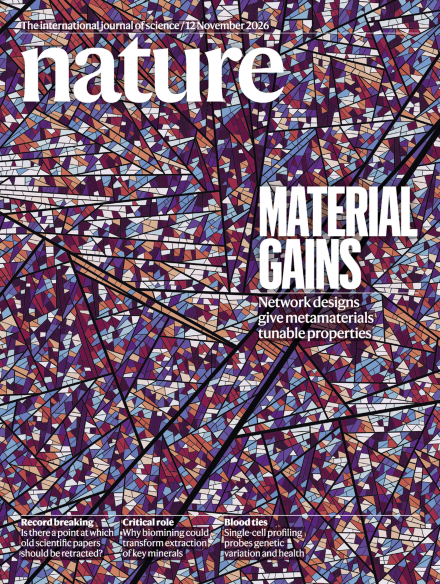
The intricate connections and complexities of real-world interactions — from social-media relationships and the Internet to chemical and biological systems — have been illuminated by network science. In this week’s issue, Albert-László Barabási and colleagues offer a different use for this discipline: the design of metamaterials. Rods of varying lengths and thicknesses are connected in mathematically predictable ways to create metamaterials that the researchers describe as ‘scale-rich’: the widths and number of connections span several orders of magnitude. Realized via 3D printing, the resulting materials have unusual properties, including resistance to deformation, which can be tuned in specific directions. The cover image captures the basic 2D structure that marks the starting point for metamaterial creation.
Cover image: Csaba Both and Albert- László Barabási.
Agricultural biotechnology once found itself in opposition to environmental science. Now it could reduce the impact of food systems on global warming and biodiversity loss.
Artificial intelligence could take the field into new territory, but researchers must create the rules and institutions that keep humans at its centre.
Global leaders at the COP17 biodiversity summit complained that companies using public genetic data are not paying into a voluntary fund to protect nature.
For years, researchers have studied people with a genetic predisposition to Alzheimer’s and other dementias. They might have even more to learn from those who don’t get the disease.
Network science has inspired the design of materials that spread out their deformation when a force is applied, have tunable stiffness and can control vibrational waves.
A cellular fuel called lactate is channelled directly into energy-generating organelles in heart muscle, defying the prevailing view about lactate transport.
In nematodes, a metabolite induced by the cold links low temperatures to a body-wide signal that promotes longevity. This signalling system is also seen in human cells.
A map of Africa’s water demand reveals that the scarcity of water is only part of the problem facing the continent — management is a separate challenge.
An imaging algorithm using closure-invariant formalism and diffusion-based reconstruction applied to supermassive black hole very long baseline radio interferometry datasets enables independent recovery of the ring-like shadow and mass that is free from the usual calibration and imaging assumptions.
A programmable neutral-atom quantum simulator is used to explore quench dynamics in spin models with up to 180 qubits, revealing prethermal dynamical phase transitions and resonant melting.
Metrology techniques are developed to characterize and control attosecond hard X-ray pulses, directly measuring a 170-attosecond duration and enabling ultrafast studies of electronic dynamics in quantum systems.
Rationally engineered molecular spatial conjugation is used for the formation of highly ordered, conformal self-assembled molecules, enabling the fabrication of high-performance perovskite/silicon tandem solar cells.
A network-science-based framework that embeds network heterogeneity into mechanical metamaterials is used to produce scale-rich metamaterials that exhibit properties inaccessible to traditional single-scale systems.
Using deuterium as a proxy for hydrogen, atom probe tomography provides experimental evidence for interstitial hydrogen in solid solution across different FCC phases, consistent with theoretical predictions of hydrogen affinity, revealing hydrogen partitioning in structural alloys.
A two-dimensional reticular triaxial woven network material is constructed by incorporating C3-symmetric macrocycles into a triangular weave pattern, enabling an extra topological dimension to be used for the construction of functional materials.
An electrolyte framework that harnesses anionic chemistry to coordinate the interfacial microenvironment and molecular interactions enables reversible four-electron iodine conversion in halogen-free aqueous electrolytes, and is validated in metal–iodine batteries.
A biocatalytic aziridination and ring-expansion cascade enables direct, enantioselective synthesis of clinically relevant and discovery-stage chiral oxazolidinones from simple alkenes.
Africa-wide water demand analysis across six sectors in 2020 shows that in specific regions of northern and southern Africa, the current water demand exceeds water availability.
A 1,000-year lake-sediment record from southeastern Australia shows that colonial disruption of Indigenous cultural burning transformed open woodland into dense, flammable forest, priming the landscape for today’s climate-driven wildfires.
New anatomical evidence reclassifies Westlothiana as an aquatic stem tetrapod, showing that terrestrial limb adaptations evolved mosaically in transitional amphibious environments before crown tetrapods emerged.
Restudy of a challenging fossil using cross-polarized light imaging and phylogenetic reconstruction identifies Chosha praecursor, a probable early-diverging insect, helping to bridge the longstanding ‘hexapod gap’ in the fossil record.
Phase 1 of TenK10K takes single-cell RNA sequencing and matched whole-genome sequencing data from 1,925 individuals, enabling detection of associations for common and rare genetic variants, the latter of which have been uncharacterized in their impact on cell-specific gene expression.
Single-cell chromatin accessibility profiling identifies cell-type-specific and cell-state-specific genetic effects that link non-coding variants to immune disease risk.
Whole-genome sequencing and cell-level gene expression measurements show that length variation in tandem repeats in the human genome contributes to cell type-specific differences in gene regulation and expression, as well as the architecture of complex traits.
Single-cell RNA-sequencing shows that cell-type-specific expression quantitative trait loci drive much of complex trait heritability, highlighting cell-type-specific gene regulation as key to linking genetic variants with traits.
Dorsal and ventral noradrenergic neurons in the locus coeruleus form topographic subpopulations whose projection patterns and activity encode choice switching, reward-prediction errors and disregard of reward-predictive cues, supporting flexible learning behaviour.
Primary cultured haematopoietic stem and progenitor cells are used to analyse the molecular mechanisms of brain myeloid differentiation, and this platform enabled the identification of elongation factor ELP1 as an important regulator of this process.
Tissue-resident γδ T cells mount rapid, innate-like stress responses that require γδ T cell receptor signalling, revealing lineage-specific receptor dependence that underpins their conserved roles in immunosurveillance and informs therapeutic deployment.
The molecular factors and mechanisms that mediate the chromatin recruitment of activation-induced deaminase and the generation of its stalled polymerase II substrate during somatic hypermutation are identified.
By being restricted to target regions by MLLT1–MLLT3 occupancy, activation-induced deaminase activity is able to avoid most off-target mutagenesis during B cell somatic hypermutation.
In mouse myocardium, glucose oxidation persists in the absence of the mitochondrial pyruvate carrier, with mitochondrial MCT1 importing lactate into mitochondria and LDHB oxidizing it to pyruvate and NADH, sustaining cardiac energetics and preventing stress-induced heart failure.
Prime assembly enables RNA-guided integration of medium-to-large DNA sequences in human cells without requiring double-strand breaks or cell cycle progression, and supports exon recoding, transgene insertion and megabase-scale rearrangements.
Cryo-electron microscopy of a nitrogenase supercomplex from a methane-producing archaeon reveals a mechanism in which PII proteins drive assembly of such structures to regulate nitrogenase activity in response to nitrogen availability.