
This page is brought to you by Brian Golding (Golding@McMaster.CA) and is copied locally here to speed your access. To go to the original page (should you find something interesting or should you wish to follow links) click on

Current Issue of Nature


Volume 658 Issue 8135, 8 October 2026
Skip to main content

Thank you for visiting nature.com. You are using a browser version with limited support for CSS. To obtain the best experience, we recommend you use a more up to date browser (or turn off compatibility mode in Internet Explorer). In the meantime, to ensure continued support, we are displaying the site without styles and JavaScript.

Volume 658 Issue 8135, 8 October 2026

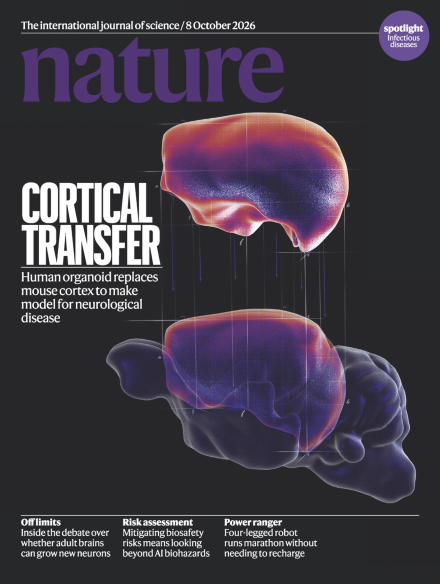
Cortical transfer

Studying how the human brain develops and functions is challenging, not least because access to living human brain tissue is understandably limited. Human brain organoids, models generated from stem cells, have proved valuable in this respect by providing a way to study living neural cells. But these models still have limitations: they are typically not integrated with other brain structures and offer limited insight into circuit-level or behavioural consequences. In this week’s issue, Sergiu P. Pașca and colleagues present an experimental model designed to overcome some of these limitations. The researchers developed a genetic strategy to generate mice lacking most of the cerebral cortex and hippocampus, creating space into which they grafted a human cortical organoid, generating what they call a ‘xenocortical mouse’. The grafted organoids grew extensively, differentiated into a diverse range of human neural cell types and organized into neural circuits that integrated with the host brain. The researchers were also able to use the model to assess aspects of behaviour and examine the effects of neurological injury. The team suggests that this model could aid the study of human neurodevelopment, neurological and psychiatric disorders, and potentially therapeutic interventions. The work was conducted under extensive ethical oversight, and the team emphasizes the importance of developing appropriate guidance as the field considers the scientific, medical, social and ethical implications of such models.

Cover image: Mesa Schumacher
This Week

Top of page ⤴

News in Focus

Top of page ⤴

Books & Arts

Top of page ⤴

Opinion

Top of page ⤴

Work

Top of page ⤴

Research

  • News & Views

  • Reviews

  • Articles

    • Gas chromatography analysis of compounds formed by the superheavy element seaborgium shows that the hexacarbonyl complex Sg(CO)6 exhibits lower first bond dissociation energy than the lighter chemical homologue W(CO)6, owing to relativistic bond weakening effects.

      • Alexander Yakushev
      • Jadambaa Khuyagbaatar
      • Peter Wieczorek
      Article Open Access
    • An architectural inversion shifts integrated optical frequency comb generation from outward broadening around a central pump to filling the spectrum between two octave-separated pumps through a self-aligned parametrically driven cavity soliton, enabling robust self-referencing for future deployable on-chip frequency and time metrology.

      • Grégory Moille
      • Pradyoth Shandilya
      • Kartik Srinivasan
      Article
    • Using an acoustic metamaterial platform, a critical topological phase transition is experimentally demonstrated establishing a hierarchical phase transition organization, in which topology shapes criticality beyond the conventional Landau–Ginzburg paradigm and standard topological phase transitions.

      • Zheyu Cheng
      • Xiuhai Zhang
      • Baile Zhang
      Article
    • Experimental evidence indicating that critical gapless topological states can be characterized by the entanglement spectrum and wavefunctions is presented, demonstrating persistence of topology at phase boundaries and extension to higher-dimensional systems.

      • Zhi-Kang Lin
      • Li-Wei Wang
      • Jian-Hua Jiang
      Article
    • Sequential on-water-surface assembly enables layer-by-layer stacking of two-dimensional polymers to create both lattice-matched and controlled lattice-mismatched van der Waals heterostructures with defined lattice registry, stacking sequence and thickness.

      • Anupam Prasoon
      • Nguyen Ngan Nguyen
      • Xinliang Feng
      Article Open Access
    • Etching-flux-mediated single-centred nucleation of two-dimensional semiconductors is used to deterministically localize a single nucleation event, expanding semiconductor deposition from controlling where materials grow to controlling where and how crystals can begin to form.

      • Jeongwon Park
      • Jiyun Kim
      • Kibum Kang
      Article Open Access
    • Thianthrenium ylides can be used as a general platform for metal–carbene generation and transfer, including cyclopropanation, σ-bond insertion and sigmatropic rearrangements.

      • Deepak Behera
      • Sagnik Chatterjee
      • Tobias Ritter
      Article Open Access
    • By combining a meta-analysis of CO2 enrichment experiments with three decades of southern African savanna observations, an increase in biomass production by C4 grasses under rising CO2 levels in water-limited environments is revealed.

      • Kimberley J. Simpson
      • A. Carla Staver
      • Colin P. Osborne
      Article Open Access
    • Newly developed methods enable construction of Icelandic haplotypes and mapping of population-scale short reads to a pangenome by reducing reference bias and improving discovery in low-mappability regions, revealing many novel variants, including pathogenic alleles.

      • Guillaume Holley
      • Hannes P. Eggertsson
      • Bjarni V. Halldorsson
      Article Open Access
    • In mice, a sparse population of sleep-active long-range inhibitory neurons in the neocortex promote widespread cortical synchronization and sleep, revealing a cortical mechanism that contributes to the regulation of sleep.

      • Jacob M. Ratliff
      • Geoffrey Terral
      • Renata Batista-Brito
      Article Open Access
    • In Drosophila, the protein Lsp2, which is induced by dietary essential amino acids, is a key physiological effector of mTORC1, and mutant flies that lack the Lsp2 gene exhibit reduced translation of TOP mRNAs and improved longevity.

      • Jun Wang
      • Zixin Cai
      • Zongzhao Zhai
      Article
    • Isotope tracing is used to determine the fate of larval dietary amino acids in adult flies, and identifies Lsp2 as a key regulator of translation and lifespan that forms the molecular basis of the effects of early-life protein restriction.

      • Hina Kosakamoto
      • Rina Okada
      • Fumiaki Obata
      Article Open Access
    • A specific population of macrophages that express high levels of the enzyme PLA2G2D in tumour-draining lymph nodes is associated with poor prognosis in patients, and inhibiting PLA2G2D improves anti-tumour immunity in mouse models.

      • Anneloes van Krimpen
      • Julie Huang
      • Floris Dammeijer
      Article Open Access
    • Covalent, membrane-impermeable caspase inhibitors exploit transient GSDMD pore formation to enter pyroptotic cells, selectively blocking caspase-1 and caspase-11-driven pyroptosis and IL-1β and IL-18 release, enabling targeted suppression of inflammatory pathology in vivo.

      • Katarzyna M. Groborz
      • Melissa E. Truong
      • Vishva M. Dixit
      Article Open Access
    • Malva enables ultrafast, reference-free searching of raw single-cell sequences across millions of cells, transforming static transcriptomic atlases into dynamic resources for understanding the functions of sequences.

      • Daniel León-Periñán
      • Nikos Karaiskos
      • Nikolaus Rajewsky
      Article Open Access
    • Stability of extrachromosomal DNA (ecDNA) relies on microhomology-mediated end joining at fragile TA-rich sites, with FANCM suppressing break formation, suggesting that Polθ disruption may destabilize ecDNA and sensitize ecDNA-driven tumours to therapeutic intervention.

      • David Billing
      • Monica Selvaraj
      • Agnel Sfeir
      Article Open Access
    • A robotic, cell–free platform rapidly prototypes redesigned genetic codes, enabling the translation of proteins with reassigned codons and non-standard amino acids without altering living genomes.

      • Felix Radford
      • Nayan Sapers
      • George M. Church
      Article Open Access
    • During replisome assembly of monkeypox virus, the hexameric helicase–primase E5 undergoes large-scale conformational changes that allow two of its primase domains to interact with the polymerase F8 thumb domain and A22 subunit, activating the helicase–primase.

      • Zishuo Yu
      • Pradeep Sathyanarayana
      • Jonathan Abraham
      Article Open Access
Top of page ⤴

Amendments & Corrections

Top of page ⤴

Spotlight

  • In this spotlight, Nature investigates the different strategies being used to curb the spread of infectious diseases.

    Spotlight
Top of page ⤴
Nature Briefing

Sign up for the Nature Briefing newsletter — what matters in science, free to your inbox daily.

Get the most important science stories of the day, free in your inbox. Sign up for Nature Briefing

Search

Quick links