
Volume 658 Issue 8136, 15 October 2026
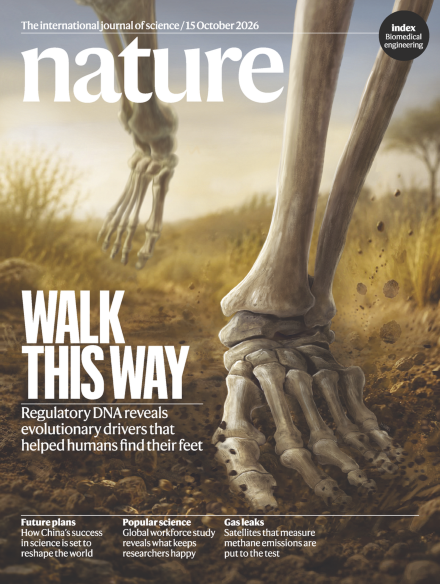
Walk this way.
Some of the fundamental differences between humans and other apes lie in their skeletons. Evolutionary changes that shaped the human skeleton opened the way to key adaptations, such as walking upright on two legs and larger craniums that could accommodate bigger brains. But the genetic changes that gave rise to the human form are largely unknown. In this week’s issue, David Gokhman, Fumitaka Inoue and colleagues work to change that by mapping the gene-regulatory changes that helped drive the evolution of the human skeleton. Using cells found in cartilage called chondrocytes, the researchers generated a genome-wide atlas of human-specific changes in gene regulation and the genetic sequence variants that drive them. The researchers also shed light on the cost of the bipedal human skeleton: they found a marked suppression of glycosaminoglycan biosynthesis in humans, which could help to explain why humans are so susceptible to degenerative skeletal diseases.
Cover image: Maayan Harel
This Week
-
Editorial
-
Advertisement
-
-
World View
-
Research Highlights
News in Focus
-
News
-
Features
Books & Arts
-
Book Review
Opinion
-
Comment
-
Correspondence
Work
-
Feature
-
Technology Feature
Research
-
News & Views
-
Articles

