This page is brought to you by Brian Golding (Golding@McMaster.CA) and is copied locally here to speed your access. To go to the original page (should you find something interesting or should you wish to follow links) click on

Current Issue of Nature


Volume 658 Issue 8138, 29 October 2026
Skip to main content

Thank you for visiting nature.com. You are using a browser version with limited support for CSS. To obtain the best experience, we recommend you use a more up to date browser (or turn off compatibility mode in Internet Explorer). In the meantime, to ensure continued support, we are displaying the site without styles and JavaScript.

Volume 658 Issue 8138, 29 October 2026

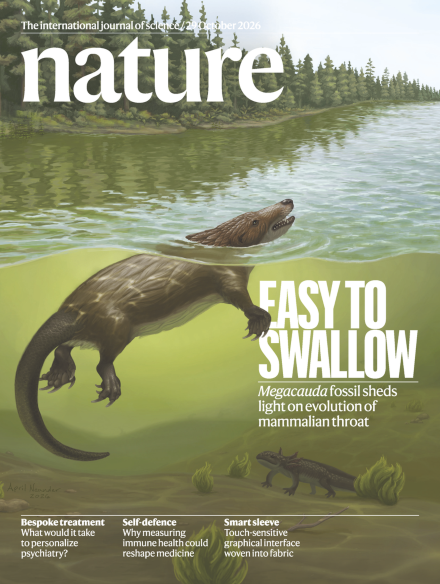
Easy to swallow

The cover shows an artist’s impression of Megacauda sungei, a predecessor to modern mammals that lived some 165 million years ago in what is now Inner Mongolia. This fossil animal is described in this issue by Zhe-Xi Luo, Chang-Fu Zhou, Thomas Martin and colleagues, where they reveal that Megacauda was semi-aquatic and could dig and swim like the modern platypus. But it is the remarkable preservation of Megacauda’s throat that makes this fossil particularly noteworthy. This allowed the researchers to infer that Megacauda had both a soft palate and constrictor muscles, providing rare evidence for a pharynx, the machinery that allows modern mammals (apart from monotremes such as the platypus) to suckle milk and to swallow liquids and food without them getting into the airway. This suggests these abilities evolved in a common ancestor of Megacauda long before mammals appeared on the planet.

Cover image: April I. Neander.
This Week

Top of page ⤴

News in Focus

Top of page ⤴

Books & Arts

Top of page ⤴

Opinion

Top of page ⤴

Work

Top of page ⤴

Research

  • News & Views

  • Reviews

  • Articles

    • A triplet carbene molecule in a tailored crystal provides a stable single-molecule spin–photon interface with millisecond coherence, advancing chemically engineered molecular qubits for quantum networking.

      • Simon Roggors
      • Thomas Unden
      • Ilai Schwartz
      Article Open Access
    • All-antiferromagnetic tunnel junctions can display both a large TMR and a reciprocal switching effect, octupole-driven spin-transfer torque, enabling nanoscale magnetic memory and potentially room-temperature terahertz spintronic devices.

      • Jaimin Kang
      • Mohammad Hamdi
      • Pedram Khalili Amiri
      Article
    • Multifunctional digital fibres integrate display, touch sensing, computation and multimodal input–output, enabling flexible, washable garments with interactive graphical interfaces and wireless multimedia capabilities.

      • Heng Fu
      • Ziang Li
      • Tural Khudiyev
      Article
    • Planar carbon pentaheptite nanoribbons are synthesized by laterally fusing polypentalene chains transformed from pre-synthesized polycyclooctadiene chains, suggesting a possible route towards carbon quantum wires.

      • Jianmin Huang
      • Qitang Fan
      • Bing Wang
      Article
    • Salt marsh platforms resist erosion under extreme waves, but vegetation damage reduces wave attenuation; substantial wave attenuation by vegetation is mainly limited to low-energy marsh coasts with waves below 1 m.

      • Pim W. J. M. Willemsen
      • Victoria G. Mason
      • Bas W. Borsje
      Article Open Access
    • An analysis of UK banking data reveals that people who reported being victim-survivors of financial abuse experience worse financial outcomes compared with a control group.

      • Anna Trendl
      • Nicola Sharp-Jeffs
      • David Leake
      Article Open Access
    • Anoxic live-cell imaging shows actin-dependent crawling motility and dynamic protrusions in Asgard archaea, providing insights into cellular innovations that may have contributed to eukaryotic evolution.

      • Philipp Radler
      • Tobias Viehboeck
      • Christa Schleper
      Article Open Access
    • Single-cell and spatial multiomics are combined to define niches in the developing human heart, revealing pacemaker-cell organization, cardiomyocyte maturation and compaction, and developmental perturbations associated with trisomy 21.

      • James Cranley
      • Kazumasa Kanemaru
      • Sarah A. Teichmann
      Article Open Access
    • Paper2Agent converts research papers into interactive artificial intelligence agents by turning manuscripts, code and data into model context protocol-based tool-invoking systems that reproduce original results, answer new scientific queries and collaborate to generate novel insights.

      • Jiacheng Miao
      • Joe R. Davis
      • James Zou
      Article Open Access
    • Base editing of NANOG in human embryos reveals its essential role in epiblast pluripotency, showing that loss of NANOG disrupts pluripotent epiblast specification and instead cells differentiate towards primitive endoderm and trophectoderm, which highlights base editing as a precise, non-genotoxic tool for studying human development.

      • Oliver J. Bower
      • Ana E. R. Orsi
      • Kathy K. Niakan
      Article Open Access
    • Emerging infectious disease outbreak risks are ubiquitous worldwide, and highest in landscapes where people, livestock and fragmented natural ecosystems coexist, but detection and data on outbreaks are currently limited by inequalities in healthcare access.

      • Rory Gibb
      • Sadie J. Ryan
      • Colin J. Carlson
      Article Open Access
    • A proximity-mapping atlas defines tumour-associated proximity antigens, revealing disease-associated membrane spatial communities, and identifies EGFR–CDCP1 as a co-target pair that enhances tumour killing by multispecific therapeutics.

      • Cody Scandore
      • Clare F. Malone
      • Olugbeminiyi O. Fadeyi
      Article Open Access
Top of page ⤴

Amendments & Corrections

Top of page ⤴
Nature Briefing

Sign up for the Nature Briefing newsletter — what matters in science, free to your inbox daily.

Get the most important science stories of the day, free in your inbox. Sign up for Nature Briefing

Search

Quick links