
Volume 657 Issue 8131, 10 September 2026
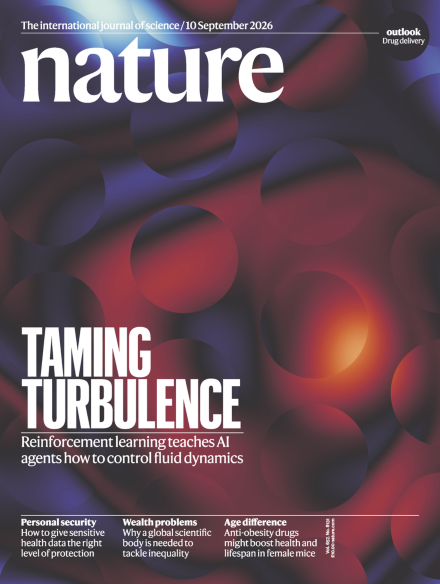
Taming turbulence
From aviation to wind turbines to blood flow, the turbulent flow of fluids presents significant challenges in physics, engineering and medicine. The root of the problem is the fact that turbulence is complex and notoriously hard to control. In this week’s issue, Christian Lagemann and colleagues tackle the problem with a reinforcement learning platform called HydroGym, which can be used to train AI models to control fluid flow. The HydroGym platform features more than 60 benchmarked fluid dynamics environments covering 2D and 3D scenarios, from cavity flows to airfoils, that AI agents can interact with and learn from. Using reinforcement learning, in which the AI agents are rewarded for taking actions that move them closer to a given goal, HydroGym was able to train agents to control turbulent flow in specific environments. The cover shows a snapshot of simulated 2D turbulence, with swirling vortices rendered in colour; the highlighted circles mark the points in the flow where the AI agent takes its readings, the sensory information it relies on to learn how to control the turbulence. Crucially, the researchers note that the agents were then able to use this knowledge to improve flows in environments they had not previously experienced. This, the team suggests, shows that agents trained on HydroGym go beyond recording individual solutions to extract underlying principles of flow control that can be used in different situations without additional training.
Cover image: Kelly Krause/Nature; Christian Lagemann/Univ. Washington.
This Week
-
Editorial
-
Advertisement
-
-
World View
-
Research Highlights
News in Focus
-
News
-
Features
Books & Arts
-
Book Review
Opinion
-
Obituary
-
Comment
-
Correspondence
Work
-
Feature
-
Technology Feature
-
Probing the proteome at cellular scale
Collection:
-
Research
-
News & Views
-
Articles

