
This page is brought to you by Brian Golding (Golding@McMaster.CA) and is copied locally here to speed your access. To go to the original page (should you find something interesting or should you wish to follow links) click on

Current Issue of Nature


Volume 657 Issue 8132, 17 September 2026
Skip to main content

Thank you for visiting nature.com. You are using a browser version with limited support for CSS. To obtain the best experience, we recommend you use a more up to date browser (or turn off compatibility mode in Internet Explorer). In the meantime, to ensure continued support, we are displaying the site without styles and JavaScript.

Volume 657 Issue 8132, 17 September 2026

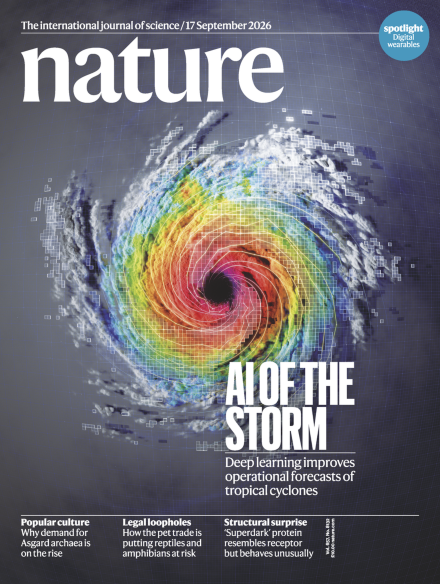
Cyclone forecast

Tropical cyclones, which include hurricanes and typhoons, are dangerous, destructive and costly. But forecasting them is extremely difficult. In this week’s issue, Ferran Alet and colleagues help to address this problem with an AI-based system called WeatherNext Cyclones that predicts the path, intensity and size of tropical cyclones up to 15 days into the future, and now provides guidance to forecasters at the US National Hurricane Center and other agencies worldwide. When tested on cyclones from 2023 to 2025, its predictions offered, on average, an extra day of lead time over leading operational models. Notably, its intensity forecasts come from atmospheric data much coarser than those used by specialized regional models, indicating that low-resolution atmospheric structure is more predictive of cyclone intensity than previously recognized.

Cover image: Tom Handy/Google
This Week

Top of page ⤴

News in Focus

Top of page ⤴

Books & Arts

Top of page ⤴

Opinion

Top of page ⤴

Work

Top of page ⤴

Research

  • News & Views

  • Perspective

    • The evidence for biological degradation of non-hydrolysable synthetic polymers is critically evaluated to propose best-practice principles for experimental design that should promote reproducibility and impact across this field.

      • Anton A. Stepnov
      • Allison Werner
      • Gustav Vaaje-Kolstad
      Perspective
  • Articles

    • Observations from the JWST reveal an unexpectedly abundant population of little red dots and overmassive black holes in the early Universe, which are confirmed by their formation in fully cosmological radiation-hydrodynamic simulations.

      • Sunmyon Chon
      • Shingo Hirano
      • Volker Springel
      Article Open Access
    • Absorption spectroscopy of thorium-229 nuclear excited states in a thorium-doped calcium fluoride crystal demonstrates a path towards a much more efficient way to build a highly stable and robust solid-state optical nuclear clock.

      • I. Morawetz
      • T. Riebner
      • E. Peik
      Article Open Access
    • Observations of a memory effect in the p-wave superconductor candidate UTe2, which can be controlled by varying the strength and duration of the electrically applied stimuli, are described.

      • Zheyu Wu
      • Hanyi Chen
      • Alexander G. Eaton
      Article Open Access
    • A framework consisting of advanced epitaxy and layer lift-off techniques uses heterogeneous photonic integration of single-crystalline nanomembranes to infuse desired functionalities into silicon and silicon nitride photonics, demonstrating ultraefficient electro-optical and magneto-optical modulation.

      • Yuan Meng
      • Wenbo Mao
      • Sang-Hoon Bae
      Article
    • Scaffolded DNA Computer performs diverse computations while thermodynamically relaxing towards equilibrium, demonstrating simplicity, reusability, speed, robustness and scalability of the approach by running 10 programs, including parity, multiplication and 25-bit addition.

      • Tristan Stérin
      • Abeer Eshra
      • Damien Woods
      Article Open Access
    • Using mass photometry combined with a single-molecule trapping method allows real-time monitoring of the assembly of individual virus-like particles with molecular resolution, enabling observation and quantification of their self-assembly pathways and dynamics.

      • Roi Asor
      • Dan Loewenthal
      • Philipp Kukura
      Article Open Access
    • A new framework combining experimental and computational methods to track ions and water present at an electrode interface allows the molecular structure and evolution of electrical double layers far from equilibrium to be discovered.

      • Xiao-Yu Li
      • Yu-Chen Cai
      • Tao Wang
      Article
    • An AI forecasting system called WeatherNext Cyclones can predict the track, intensity (maximum wind speed) and size of tropical cyclones with an accuracy gain over leading operational models comparable to a decade of progress in numerical forecasting.

      • Ferran Alet
      • Tom R. Andersson
      • Peter Battaglia
      Article Open Access
    • Remote phone-based targeted tutoring in five countries produced large, cost-effective learning gains during school closures, outperforming text messaging and working effectively when delivered by governments or non-governmental organizations to strengthen education resilience.

      • Noam Angrist
      • Micheal Ainomugisha
      • Tim Sullivan
      Article Open Access
    • Human brain organoids were developed for over five years in culture to demonstrate that brain cells can continue to mature and record the passage of time, following human-specific endogenous programs, even outside the context of the organism.

      • Irene Faravelli
      • Noelia Antón-Bolaños
      • Paola Arlotta
      Article Open Access
    • Stimulation of human cortex reorganizes neural assemblies and induces cell-type-specific gene regulatory programs, establishing an ex vivo framework that links stimulation parameters to circuit and transcriptional responses for designing targeted neuromodulatory therapies.

      • Haley Moore
      • Mantre Dehnad
      • Genevieve Konopka
      Article
    • Virtual Tissues (VirTues), a foundation model for spatial proteomics that captures tissue organization across scales, supports marker reconstruction, cell segmentation and typing, niche annotation, spatial biomarker discovery and patient stratification across heterogeneous panels and datasets.

      • Johann Wenckstern
      • Eeshaan Jain
      • Charlotte Bunne
      Article Open Access
    • A clinically annotated multi-omic organoid resource with matched tumour samples from 256 patients across 5 cancers maps gene dependencies, reveals subtype-specific vulnerabilities and uncovers treatment-driven changes, expanding mechanistic insight and models for precision oncology.

      • C. Herranz-Ors
      • S. G. Bhosle
      • T. D. L. Crosby
      Article Open Access
    • The international collaboration of the Human Cancer Models Initiative presents a comprehensive resource of next-generation cancer models from 2,780 donors with 25 cancer types and integrated tumour–model genomic, transcriptomic and epigenomic analyses.

      • Dina ElHarouni
      • Mushriq Al-Jazrawe
      • Zhenyu Zhang
      Article Open Access
    • Integration of genome-scale CRISPR screening data from traditional cell lines and next-generation cancer models expands the representation of tumour subtypes and genomic alterations in The Cancer Dependency Map.

      • James V. Neiswender
      • Samuel Maffa
      • Francisca Vazquez
      Article Open Access
    • Screening of chromosome arm-level aneuploidies uncovers that these alterations select for specific basal-like breast cancer driver genes, including PLGRKT, an oncogene whose tumour-promoting activity is associated with highly stress-resistant mitochondria and enhanced detoxification of reactive oxygen species.

      • Khalid N. Al-Zahrani
      • Ellen R. Langille
      • Daniel Schramek
      Article
    • Chemotherapy, particularly with platinum-based drugs, is associated with substantial, rapidly detectable mutagenesis in childhood cancers, tripling private signatures and doubling mutation burden, highlighting therapy-induced tumour evolution and opportunities for safer, de-escalated treatment.

      • Mehdi Layeghifard
      • Marcos Díaz-Gay
      • Adam Shlien
      Article Open Access
    • Cryo-electron microscopy sheds light on the architecture of the Trypanosoma brucei mitochondrial editosome and reveals how this assembly mediates mRNA editing through the insertion and deletion of uridine nucleotides.

      • Yun-Tao Liu
      • Andres F. Vacas
      • Ruslan Aphasizhev
      Article
    • TM184C—an ancient G-protein-coupled receptor-like superdark protein involved in regulation of autophagy, intercellular connectivity and material exchange—underscores the promise of exploring the understudied human proteome and beyond.

      • Kyutae D. Lee
      • Samuel Taylor
      • Daniel G. Isom
      Article Open Access
Top of page ⤴

Amendments & Corrections

Top of page ⤴

Spotlight

  • Digital health wearables are rising in prominence in the consumer market, where they are used to test for health indicators such as heart rate and sleep quality.

    Spotlight
Top of page ⤴
Nature Briefing

Sign up for the Nature Briefing newsletter — what matters in science, free to your inbox daily.

Get the most important science stories of the day, free in your inbox. Sign up for Nature Briefing

Search

Quick links