
This page is brought to you by Brian Golding (Golding@McMaster.CA) and is copied locally here to speed your access. To go to the original page (should you find something interesting or should you wish to follow links) click on

Current Issue of Nature


Volume 657 Issue 8133, 24 September 2026
Skip to main content

Thank you for visiting nature.com. You are using a browser version with limited support for CSS. To obtain the best experience, we recommend you use a more up to date browser (or turn off compatibility mode in Internet Explorer). In the meantime, to ensure continued support, we are displaying the site without styles and JavaScript.

Volume 657 Issue 8133, 24 September 2026

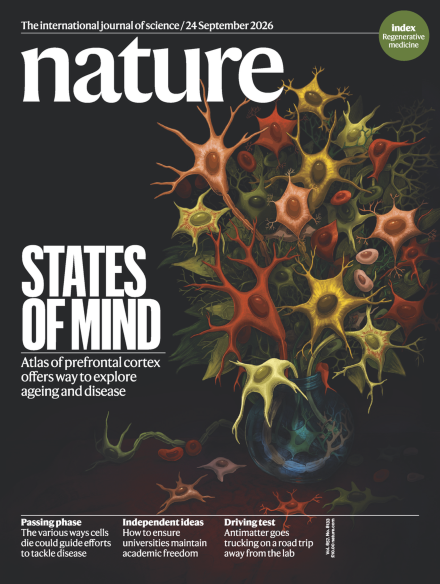
States of mind

The human brain is made up of billions of functionally diverse cells and this complexity makes it extremely challenging to understand what is happening as the organ ages or becomes subject to disease. In this week’s issue, the PsychAD Consortium opens a window on the human brain with a single-cell transcriptomic atlas of the prefrontal cortex. This part of the brain is heavily involved in decision-making, self-control and emotions, and its dysfunction has been linked to psychiatric conditions as well as degenerative diseases such as Alzheimer’s. The atlas contains more than 6.3 million nuclei from the brains of 1,494 individuals, including those without any diagnosed disorders as well as those who had conditions such as Alzheimer’s, Parkinson’s and schizophrenia. In the first of three papers in this issue, the consortium reveals the full atlas and defines gene-expression patterns associated with eight diseases, focusing in particular on Alzheimer’s. The second paper uses data from those brains with no signs of disorder to build an atlas of cell-specific RNA expression in the prefrontal cortex from infancy to late adulthood. And the third paper uses single-nucleus transcriptomics to map how genetic risk for brain disorders affects specific cell types. Together with a set of papers published simultaneously in other journals, this work opens fresh paths for exploring brain ageing and disease.

Cover image: Jessica S. Johnson
This Week

Top of page ⤴

News in Focus

Top of page ⤴

Opinion

Top of page ⤴

Work

Top of page ⤴

Research

  • News & Views

  • Analysis

    • Integrating satellite-derived war-damage data with text-based fatality records through improvement, enrichment and fusion mitigates limitations inherent in each source, revealing complex violence dynamics beyond fatality-centric paradigms, as case studies from Ukraine and Myanmar illustrate.

      • Valerie Sticher
      • Corinne Bara
      • Jan Dirk Wegner
      Analysis Open Access
  • Articles

    • The kine neural reconstruction algorithm produces high-resolution, time-continuous very long baseline interferometry videos, enabling direct measurement of instantaneous plasma velocities and detailed kinematic analysis of relativistic astrophysical jets.

      • Marianna Foschi
      • Brandon Zhao
      • Aviad Levis
      Article Open Access
    • Researchers demonstrate successful road transport of trapped antiprotons, establishing a practical method for moving antimatter to quieter laboratories and substantially improving future tests of matter–antimatter symmetry.

      • M. Leonhardt
      • J. Morgner
      • C. Smorra
      Article Open Access
    • Vacuum fluctuations provide an important new way to control material properties non-invasively and can enhance superconductivity, which is shown by an increase in the critical temperature of superconducting NbSe2, a layered transition-metal dichalcogenide.

      • Zheyan Wang
      • Gabriel Cardoso
      • Changgan Zeng
      Article
    • Chemically stable lead carboxylates are used as surface passivators for engineered perovskite films to manufacture metre-scale solar modules that can achieve record-high certified efficiencies, as well as passing all IEC 61215 reliability tests.

      • Dongdong Xu
      • Ke Xiao
      • Hairen Tan
      Article
    • Deep-foam photolithography uses light-controlled polymer foaming to create high-resolution, multifunctional microstructures with tunable optical, wetting and fluid-handling properties for advanced manufacturing applications.

      • Detao Qin
      • Xianghui Liu
      • Easan Sivaniah
      Article
    • Nine-residue peptides can encode discrete interaction motifs that direct the formation of hexagonal pores, which hierarchically tile into laterally expandable multichannel nanofibrils with defined topology.

      • Jasmina Gačanin
      • Francesca Mazzotta
      • Tanja Weil
      Article Open Access
    • A generative committor-guided path-sampling framework reconstructs rare biomolecular transition pathways and reveals the underlying thermodynamics and kinetics without using predefined collective variables or brute-force sampling, at an acceptable computational cost.

      • Chenyu Tang
      • Mayank Prakash Pandey
      • Christophe Chipot
      Article
    • New Mongolian fossil evidence shows zhelestids were not placental-like herbivore relatives, but a dental variant within Zalambdalestoidea, with distinctive molars alongside zalambdalestid skull and limb traits.

      • Andres Giallombardo
      • Eva A. Hoffman
      • Michael J. Novacek
      Article
    • Single-molecule long-read sequencing of human sperm reveals variation in recombination across donors and that a substantial fraction of non-crossover gene conversions arises before meiosis, distinct from PRDM9-driven recombination and associated with fragile sites.

      • Regev Schweiger
      • Sangjin Lee
      • Richard Durbin
      Article Open Access
    • Experimentally replaying tumour evolution in divergent mouse strains reveals the importance of interactions between genetic ancestry and acquired cancer-driving mutations in shaping the earliest stages of cancer development.

      • Sarah J. Aitken
      • Frances Connor
      • Erika López-Arribillaga
      Article Open Access
    • M12 is a metabolically activated molecular glue that recruits diverse proteins to DCAF11 for ubiquitin-mediated degradation, revealing a glutathione-dependent mechanism that broadens targeted protein degradation across multiple substrates.

      • Hojong Yoon
      • Franziska Wachter
      • Benjamin L. Ebert
      Article Open Access
    • Probabilistic sequence encoding from language model embeddings within a generative AI framework enables protein miniaturization, modification and augmentation while maintaining native architecture and functional integrity.

      • Kapil Devkota
      • Daichi Shonai
      • Rohit Singh
      Article Open Access
    • The cryo‑EM structure of the Oryza sativa photosystem II–light harvesting complex II supercomplex in its native membrane reveals the intact plant photosystem architecture, retaining physiologically relevant proteins and lipids that are otherwise lost during purification.

      • Jiao Li
      • Eduard Elias
      • Jiapeng Zhu
      Article Open Access
Top of page ⤴

Amendments & Corrections

Top of page ⤴

Collections

  • Regenerative medicine has the potential to transform the treatment of chronic and life-threatening diseases.

    Nature Index
  • The combination of artificial intelligence and automation is transforming laboratory research.

    Technology Feature
Top of page ⤴
Nature Briefing

Sign up for the Nature Briefing newsletter — what matters in science, free to your inbox daily.

Get the most important science stories of the day, free in your inbox. Sign up for Nature Briefing

Search

Quick links