
Volume 658 Issue 8134, 1 October 2026
Family secrets
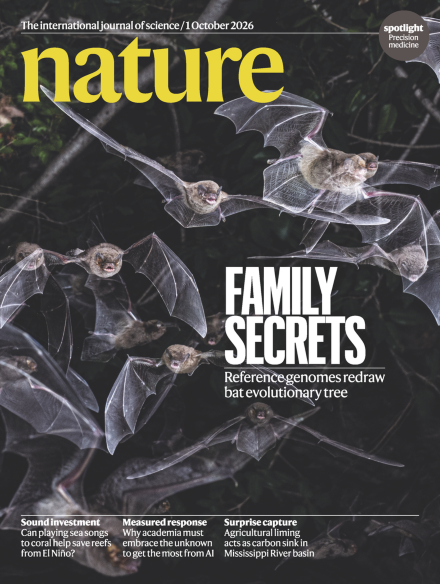
The cover captures an aerial gathering of Natal long-fingered bats (Miniopterus natalensis). Bats are extraordinary creatures — they are the only mammal capable of powered flight, have remarkable disease resistance, use echolocation for navigation, hibernate and have longer than expected healthspans. But our knowledge of bat evolution and their remarkable adaptations is far from complete. In this week’s issue, Emma Teeling, Michael Hiller, Liliana Davalos, Sonja Vernes, David Ray and their Bat1K consortium colleagues present genomes for 103 bat species, representing all 21 bat families. Using these data, the researchers were able to redraw the bat phylogenetic tree, resolving some contested relationships among species as well as identifying the factors that originally caused the confusion. The team was also able to combine the genomic data with fossil data to probe the question of how long ago and where bats originated, estimating that they arose about 60 million to 65 million years ago in Europe.
Cover image: Brock and Sherri Fenton.
This Week
-
Editorial
-
Advertisement
-
-
World View
-
Research Highlights
News in Focus
-
News
-
Features
Books & Arts
-
Book Review
Opinion
-
Comment
-
Correspondence
Work
-
Feature
-
Technology Feature
-
Bigger than CRISPR? A guide to the latest genome editors
Technology Feature:
-
Research
-
News & Views
-
Reviews
-
Articles

